
A defense engineer at a Tier 2 subcontractor downloads a CAD file from a secure transfer portal to review before a supplier meeting. The portal logged a clean download event. The engineer opens the file on their laptop at the hotel. Their laptop has been on the hotel's public Wi-Fi for the past hour.
The portal did everything right, but the ITAR-controlled technical data is now in an environment nobody designed security controls for.
This scenario is not unusual. It is routine. Historically, the compliance conversation has been almost entirely focused on the transfer, not on what happens to the file after it arrives.
Why Does ITAR Compliance Tend to Focus on the Transfer Event?
The regulatory architecture of ITAR creates a natural focus on transfer. 22 CFR § 120.54's encryption safe harbor specifically governs the export event. It establishes conditions under which a transfer of controlled technical data does not require an individual export license. Compliance teams spend their energy satisfying those conditions: FIPS 140-3 validated encryption, US Person key control, audit documentation of the transfer.
That focus is not misplaced. Satisfying the safe harbor is genuinely important, and most of the platforms evaluated in What Are the Best ITAR-Compliant File Transfer Solutions in 2026? are designed specifically to satisfy it.
The problem is architectural: the safe harbor protects the transfer. ITAR protects the technical data, full stop.
22 CFR § 120.50 defines "export" broadly; it includes not just the initial transmission of controlled technical data to a foreign national, but any unauthorized disclosure, release, or transfer. A file left unencrypted on a shared drive that a non-U.S. person can reach is a potential export event. A file stored in plaintext on a laptop that is lost, stolen, or compromised is a potential export event. Neither of these is a transfer in the conventional sense. Both carry ITAR exposure.
The transfer event is one moment in the life of a file. ITAR compliance requires that the technical data in that file is protected throughout its life.
What Typically Happens to an ITAR File After It Reaches Its Destination?
This is the part the compliance program rarely maps. Once a controlled technical data file arrives at its authorized destination — a subcontractor's file server, an engineer's laptop, a prime's project folder — it enters an environment that may have a very different security posture from the transfer platform that just delivered it.
A few common patterns:
The working copy pattern: The engineer downloads the file to work on it. A local copy is created. The engineer may email a section to a colleague, save a revised version to a shared team folder, or print a page for reference during a call. Each of those actions creates a new copy of the controlled data in a new environment, with no traceability back to the original transfer event and no controls on the new copy.
The subcontractor forwarding pattern: An authorized subcontractor receives a technical specification through a compliant transfer platform. They need input from a specialist partner. They forward the file via regular email, or upload it to a shared folder in a tool the specialist's team uses. The transfer platform logged one clean outbound event. There are now three or four copies of the technical data in environments nobody reviewed.
The laptop travel pattern: An engineer downloads files before traveling to a customer site. The laptop is checked into luggage at an international departure. Or it is left in a hotel room. Or it passes through a customs inspection in a country with data forensics capability. The file on the laptop is either encrypted — in which case the exposure depends on the encryption architecture — or it is not.
The cached copy pattern: Many applications create local cached copies of files as they are opened and worked on. These caches persist after the application is closed and may not be cleared when the user thinks the file is "closed." On a shared device or a device with inadequate endpoint security, cached plaintext copies of ITAR technical data are accessible to anyone with physical or remote access to the device.
Does the ITAR Encryption Safe Harbor Apply After a File Has Been Transferred?
The safe harbor under 22 CFR § 120.54 is specifically structured around the transfer event. It provides that a transfer of technical data encrypted under qualifying conditions does not constitute an "export" requiring an individual license.
Once the file has been received and decrypted by the authorized recipient — which is what happens when an engineer downloads a file from a transfer platform and opens it — the safe harbor conditions have been satisfied for the transfer. They are not ongoing conditions that protect the file in its new environment.
If the engineer stores the decrypted file in plaintext on their laptop, the file is no longer covered by the encryption conditions of the safe harbor. If a non-US Person later accesses that laptop, that may constitute an unauthorized disclosure of ITAR technical data — an export event — regardless of how securely the original transfer was conducted.
This is the gap between transfer compliance and persistent protection. The safe harbor is satisfied at the moment of authorized transfer. ITAR's underlying obligation to prevent unauthorized access to controlled technical data continues indefinitely.
🛑 The Portal Logs a Clean Transfer. What Happens Next?
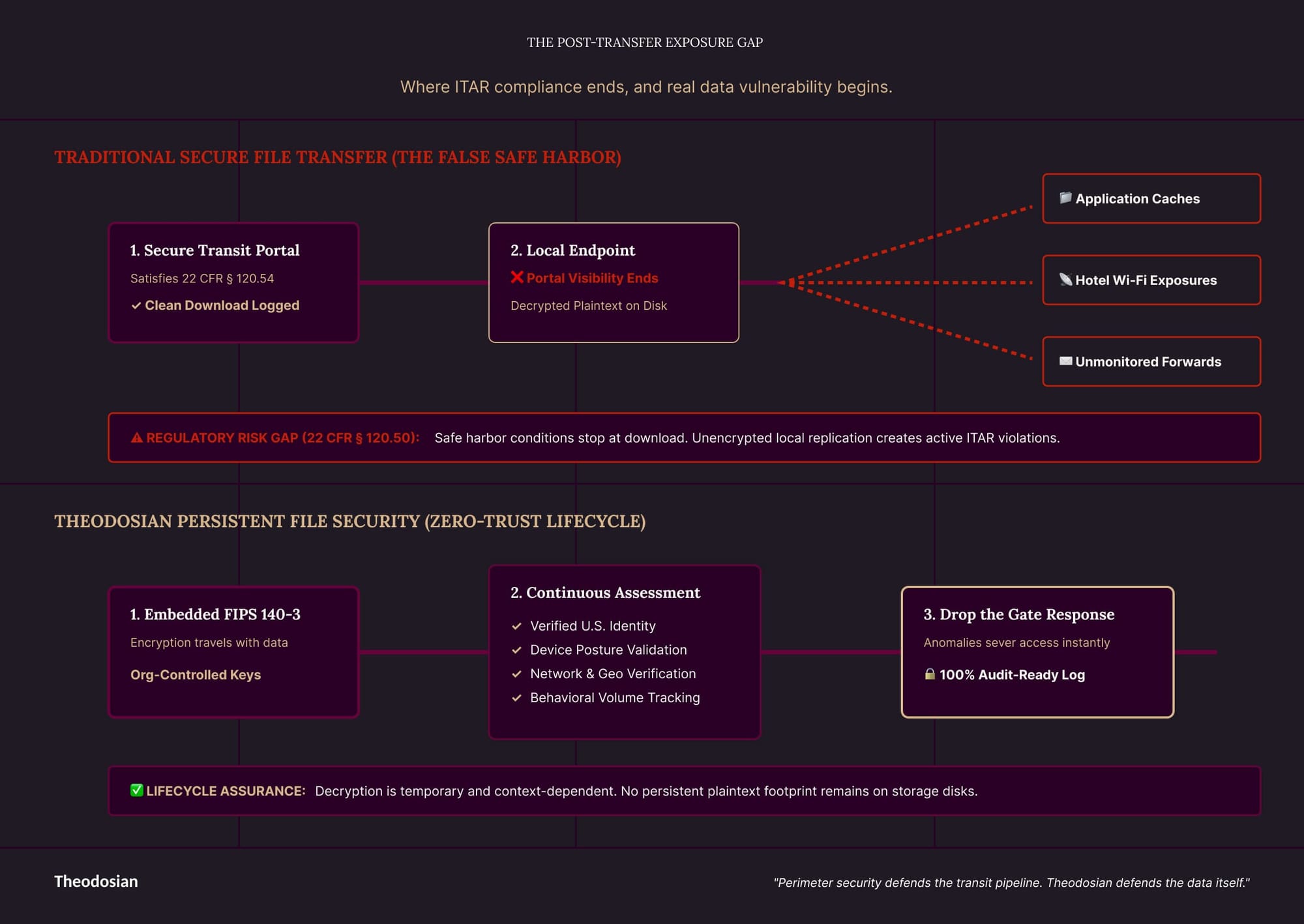
Most secure file transfer platforms act like an armored truck; they protect your ITAR technical data perfectly until it reaches the loading dock. But once a subcontractor downloads that file to an endpoint, the armored truck drives away. If that file is left unprotected on a local hard drive, your compliance safe harbor vanishes.
What Are the Most Common ITAR Exposure Events That Happen Post-Transfer?
Based on the patterns above, the most common post-transfer ITAR exposure events fall into five categories:
Unencrypted file on an endpoint: The file was transferred securely. On receipt, it was decrypted and stored in plaintext on the recipient's local drive. The endpoint is the exposure point — whether through compromise, theft, loss, or unauthorized physical access.
Forwarding by authorized recipients: Authorized recipients forward controlled technical data to colleagues, partners, or specialist reviewers without the same level of access control as the original transfer. This is often well-intentioned and operationally necessary. Without controls on the file itself, each forwarding event is an unmonitored copy.
Shared drive over-exposure: A received file is saved to a shared team folder with broader access than intended. Members of the team who are not US Persons, or who are not authorized for this specific technical data, gain access not through the transfer platform but through the shared folder.
Long-lived cached or backup copies: IT backup systems, cloud sync tools, and application caches create copies of files that are not subject to the same access controls as the original. A file deleted by the engineer may still exist in a backup, a recycle bin, a cloud sync folder, or an application cache.
Loss or theft of device: Laptop theft is the most straightforward post-transfer exposure. Without file-level encryption that persists after download, a stolen laptop is an immediate ITAR violation. A landmark corporate benchmark study by the Ponemon Institute revealed that more than 7% of all assigned corporate laptops are lost or stolen during their operational lifetime. Even worse, the study found that devices carrying the most sensitive and confidential data are the most likely targets for theft. For an aerospace or defense workforce with dozens or hundreds of devices carrying ITAR technical data, that is a massive, mathematically guaranteed actuarial exposure.
What Would Persistent ITAR Protection Look Like for Files After Transfer?
Persistent protection means the security controls travel with the file, not just with the transfer platform. The file carries its own encryption and access policy into every environment it enters.
This requires a different architecture from transfer-layer protection. The file needs to be encrypted at the file level before it is transferred, with access controls that evaluate every subsequent access request against the same policy — regardless of which environment the file is in when the request is made.
The access policy should enforce: authenticated US Person identity, verified against a trusted identity provider. Device compliance status at the moment of access. Location and network context evaluated against expected patterns. Access volume assessed against behavioral norms.
When those conditions are not met — the requester is on an unmanaged device, connecting from an unexpected location, or accessing files at unusual volume — the file remains encrypted and inaccessible. The access attempt is logged. The policy response is automatic.
This is the architecture that satisfies ITAR's underlying data protection obligation, not just the transfer event's safe harbor requirements. The file defends itself in the engineer's hotel room in the same way it defended itself in the transfer platform.
How Does File-Level Encryption Close the Post-Transfer Gap?
Theodosian's architecture applies FIPS 140-3 validated AES-256 encryption at the file layer, with unique keys per file and zero-knowledge key management — your organization holds the decryption keys, Theodosian cannot access them. The encryption and access controls are embedded in the file before transfer and persist after it arrives at its destination.
When an authorized recipient accesses a Theodosian-protected ITAR file — whether through the original transfer platform, a downloaded copy on their laptop, or a shared folder — the access request is evaluated in real time against six signal categories: authenticated identity, device compliance status, location, network type, time, and behavioral pattern. Access is granted or denied at the file layer.
Persistent policy enforcement: files are never left unprotected on local storage disks. Instead, cryptographic access is controlled in real-time by Theodosian's context engine. The file evaluates the endpoint's compliance posture, geographic location, and user identity dynamically. If all context signals pass, authorized applications can process the data safely, but no permanent, raw plaintext is ever written to disk. If any contextual check fails post-transfer, access is dynamically severed, leaving no persistent physical footprint behind for an attacker to forensically extract or steal.
If a policy condition is not met — an access attempt from an unrecognized device, a bulk download pattern consistent with exfiltration, a geographic anomaly — Drop the Gate freezes access automatically, triggers step-up MFA, and notifies the security team. The triggering conditions and response sequence are logged.
Every access event, wherever it occurs, is logged: authenticated identity, file identity, device, location, network, policy outcome. For ITAR compliance purposes, this provides audit coverage for the full lifecycle of the file; not just the transfer event.
For contractors also subject to CMMC Level 2, the same architecture satisfies SC.L2-3.13.11 (FIPS-validated encryption for CUI wherever it lives), SC.L2-3.13.10 (organization-controlled keys), and the AU domain requirements. The transfer platform and the file-level protection address different parts of the compliance requirement.
How Do You Audit Your ITAR Compliance Beyond the Transfer Event?
Most ITAR compliance audits focus on transfer records: who transferred what, to whom, under which authorization, when. Those records are necessary. They are not sufficient for a program that recognizes where the actual exposure lives.
A meaningful audit of post-transfer ITAR exposure should ask:
What is the state of controlled technical data on endpoints? Are files encrypted at the file level on the devices that hold them, or is disk-level encryption the only protection? Disk encryption protects against a powered-down device being physically stolen — it does not protect against a logged-in session on a compromised device.
What access controls apply to ITAR files on shared drives? Are access permissions scoped to US Persons with authorization for this specific technical data? Are they reviewed on a defined cadence?
Is there an audit trail for access events after the initial transfer? If an engineer accesses a transferred file from a hotel network three days after the transfer, is that event logged? Where?
What happens when an authorized recipient forwards or re-shares controlled technical data? Is there a documented process? Are those secondary distributions logged?
Is there a revocation mechanism for transferred files? If a file was transferred to a subcontractor whose personnel roster has changed, can access be revoked? Or does the technical data remain accessible to whoever has a copy?
These questions do not have good answers inside a transfer-only compliance program. They require file-level controls that follow the technical data into every environment it enters.
🛡️ Start Securing the File
ITAR violations don't necessarily happen mid-transit; they happen on hotel Wi-Fi, shared subcontractor network drives, and compromised endpoints. If your ITAR compliance ends the moment a download button is clicked, your defense program is fundamentally incomplete.
FAQs: Post-Transfer ITAR Compliance
Does ITAR compliance require encrypting files after they've been transferred?
ITAR does not specify a post-transfer encryption requirement in the way it structures the safe harbor for transfer events. However, ITAR's definition of "export" (22 CFR § 120.50) covers any unauthorized disclosure, release, or transfer of controlled technical data to a foreign national — regardless of how the data was originally obtained. An unencrypted ITAR file on a stolen laptop is a potential export event under this definition, even if the original transfer was fully compliant. The practical standard for organizations serious about their ITAR compliance posture is to maintain file-level encryption on controlled technical data throughout its lifecycle, not just during transfer.
What is the ITAR definition of a controlled technical data disclosure?
Under 22 CFR § 120.50, an "export" of technical data includes: oral or visual disclosure or transfer to a foreign national in the United States (deemed export); electronic transmission to a foreign national outside the United States; and disclosure of technical data through any other means. The scope extends beyond intentional transfers to any unauthorized access by a foreign national. An employee who shares a workspace with a non-US Person colleague, an unsecured laptop accessed by hotel staff, or a shared cloud folder with over-provisioned access can all generate disclosure events under this definition.
Who is a "US Person" for ITAR purposes?
Under 22 CFR § 120.62, a US Person is a United States citizen, a lawful permanent resident (green card holder), a protected individual as defined under 8 USC § 1324b(a)(3), or a US-incorporated organization or entity. It does not include visa holders — including H-1B, L-1, or other work visa categories — regardless of how long they have been in the United States or working for a defense contractor. For organizations with international employees, this creates one of the most common sources of inadvertent ITAR exposure in day-to-day operations.
What should defense contractors do if they discover a potential ITAR violation after a transfer?
If a potential unauthorized disclosure of ITAR-controlled technical data is discovered, the organization should consult with legal counsel experienced in export controls immediately. The Directorate of Defense Trade Controls (DDTC) at the State Department offers a voluntary disclosure program under 22 CFR § 127.12, which generally results in significantly reduced penalties compared to violations discovered through external investigation. Voluntary disclosure requires a detailed description of the violation, the technical data involved, the parties who received access, and the remedial measures implemented. Organizations that respond to a potential violation by conducting an internal investigation and making a timely voluntary disclosure are treated substantially differently than those where violations are discovered by DDTC.