
Every enterprise file encryption vendor will tell you they use AES-256. Most of them are telling the truth.
AES-256 is the standard. It's in every serious encryption product on the market. The encryption algorithm is not the variable that determines your compliance posture or your actual security. The variable is who holds the key.
An AES-256 encrypted file is completely secure — until someone with the decryption key decides to open it, is compelled to open it, or is breached in a way that exposes the key. The question isn't whether the file is encrypted. It's whether your vendor can decrypt it, whether your cloud provider can decrypt it, and whether a government subpoena served to a third party produces your sensitive files.
For ITAR's encryption safe harbor, CMMC's key management requirements, and HIPAA's access control standards, the answer to those questions is the compliance differentiator — not the bit length of the encryption key.
What Are the Three Tiers of Enterprise File Encryption?
Enterprise file encryption isn't a single architecture. There are three distinct tiers, each with different key control models, and the compliance implications are not equal.
Tier 1: Platform Encryption (Vendor-Held Keys)
The default state for most cloud storage and enterprise platforms. Your data is encrypted at rest within the platform's infrastructure, using keys generated and managed by the platform vendor.
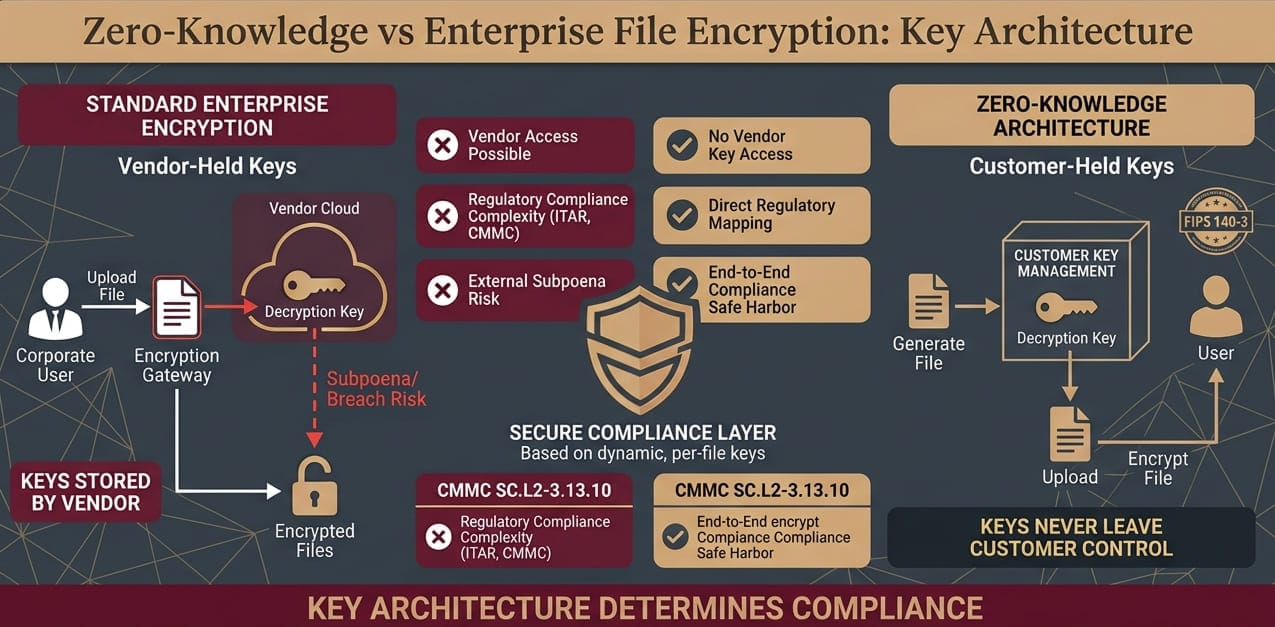
What this means: Microsoft encrypts your SharePoint data. Google encrypts your Google Drive data. Dropbox encrypts your Dropbox data. The encryption is very real. The vendor holds the keys. A government order served to Microsoft, Google, or Dropbox produces your files. A vendor breach that exposes key material exposes your data. A vendor employee with sufficient access can, in principle, read your files.
For general business data, Tier 1 is usually adequate. For ITAR-controlled technical data, it isn't. ITAR's encryption safe harbor under 22 CFR § 120.54 requires that decryption keys remain under the "exclusive organizational control" of a U.S. person. A key held by a cloud provider is not under your exclusive control; it's under theirs.
Tier 2: BYOK (Bring Your Own Key)
BYOK arrangements let organizations generate their own encryption keys and provide them to the vendor's key management service. The vendor uses your key to encrypt your data, but your key is introduced into the vendor's infrastructure.
What this means: you generate the key, but the vendor's key management service processes it. The key material enters the vendor's systems. Depending on the implementation, the vendor may hold a copy of your key, process it in a hardware security module (HSM) that you don't control, or use it in ways that create a window of vendor-accessible key material.
BYOK is significantly better than Tier 1. Whether it satisfies ITAR's "exclusive organizational control" requirement depends on the specific implementation. Many legal interpretations hold that a key processed through a vendor's infrastructure — even an HSM you nominally control — doesn't constitute exclusive organizational control, because the vendor's systems are the processing environment.
Tier 3: Zero-Knowledge Architecture (Customer-Held Keys)
Zero-knowledge encryption means the vendor's infrastructure never processes your key material. Keys are generated on your infrastructure, stored on your infrastructure, and never transmitted to or held by the encryption vendor. The vendor's system performs encryption and decryption operations, but the key itself never leaves your organizational control.
What this means: the vendor cannot decrypt your files. A government order served to the vendor produces encrypted ciphertext. A vendor breach exposes nothing of value. The vendor's employees cannot access your files regardless of their access level within the vendor's own systems.
For ITAR's exclusive organizational control requirement and CMMC's SC.L2-3.13.10 (organization-controlled cryptographic keys), Tier 3 is the architecture that satisfies the requirement by design, not by interpretation.
🔐 Stop Trusting Vendor-Held Keys With Your Compliant Data
Under ITAR § 120.54, if a third party can access your decryption keys, you lose your safe harbor. See how zero-knowledge key architecture keeps your encryption keys under exclusive organizational control, without vendor access.
How Does Information Rights Management (IRM) Fit Into This Framework?
Information Rights Management (IRM) is a set of capabilities that extend beyond encryption to include usage controls on files: preventing copy, paste, print, screenshot, or screen recording operations on protected content. IRM is sometimes used interchangeably with DRM (Digital Rights Management) in enterprise contexts.
IRM sits on top of the encryption architecture — it's a usage control layer, not a key management architecture. An IRM product can use Tier 1, Tier 2, or Tier 3 key management. The IRM capability (usage restriction) is independent of who holds the encryption key.
The difference matters because IRM and file-layer encryption are often conflated in buyer conversations. When evaluating enterprise file encryption, the relevant questions are:
- Who holds the encryption key? (key architecture — the compliance question)
- What usage controls are applied to the file? (IRM capabilities — the DRM/content extraction question)
- Where does the protection apply? (scope — the file-layer vs. platform-layer question)
A platform with strong IRM (copy/paste/print prevention) but Tier 1 key management satisfies content extraction requirements but not ITAR exclusive control. A platform with Tier 3 zero-knowledge key management but no IRM satisfies compliance key control requirements but doesn't prevent a user from manually transcribing content. The right choice depends on the specific compliance requirement.
How Do the Leading Enterprise File Encryption Approaches Compare on Key Architecture?
| Platform | Key Architecture | IRM / Usage Controls | After-Download Protection | ITAR Key Control (§ 120.54) | CMMC SC.L2-3.13.10 |
|---|---|---|---|---|---|
| Microsoft Purview + AIP | Tier 1 default / Tier 2 BYOK | ✅ Sensitivity labels + usage restrictions | Within M365 on managed devices | ❌ Vendor processes keys | Partial (BYOK routes via Azure Key Vault) |
| Virtru | Tier 3 zero-knowledge (email channel) | ❌ No copy/print prevention | ✅ For email-sent files | ✅ For email channel | ✅ For email channel only |
| Seclore | Tier 2–3 (implementation-dependent) | ✅ Full IRM — copy, paste, print, screenshot | ✅ Cross-environment | Depends on deployment | ✅ Direct mapping |
| Kiteworks | Tier 1 (FedRAMP Moderate) | ❌ Transfer controls only | ❌ Post-download | ❌ Vendor holds keys | Transfer layer only |
| Theodosian | Tier 3 zero-knowledge (patent-pending) | ❌ Roadmap — not currently shipped | ✅ All platforms + endpoints | ✅ Customer-held, vendor-blind | ✅ Direct mapping |
Microsoft Purview is widely deployed and deeply integrated into the M365 ecosystem. Its sensitivity labels and Azure Information Protection provide file-level classification and usage restrictions within the M365 environment. The key architecture is Tier 1 by default; BYOK is available but routes key material through Azure Key Vault, which Microsoft operates. For ITAR-exclusive control, this creates a gap that Microsoft's own documentation acknowledges. Customer Lockbox and similar features reduce (but don't eliminate) Microsoft's theoretical key access.
Virtru is one of the few email-channel vendors with genuine Tier 3 zero-knowledge architecture. The TDF (Trusted Data Format) standard it developed keeps keys entirely within the customer's control. The scope limitation is the channel: Virtru's zero-knowledge guarantee applies to files sent through email. Files stored in other environments aren't covered by Virtru's key management architecture.
Seclore offers the most complete IRM capability in the enterprise file security market: copy, paste, print, and screenshot prevention that works cross-environment. Its key management architecture varies by deployment configuration. For organizations with hard content extraction prevention requirements, Seclore addresses something no other platform in this table currently does. The trade-offs are deployment timeline (months) and pricing ($27,000–$50,000+ annually for typical enterprise deployments).
Kiteworks holds FedRAMP Moderate Authorization and is a strong choice for controlled transfer workflows. Its encryption operates at the platform level (Tier 1) — Kiteworks manages the keys for data within its environment. Files downloaded from Kiteworks exit the platform's key management scope.
What Does ITAR's "Exclusive Organizational Control" Requirement Actually Mean for Key Management?
22 CFR § 120.54 provides an encryption safe harbor for ITAR-controlled technical data: data encrypted with FIPS 140-2/3 validated cryptography and controlled with keys under exclusive U.S. person organizational control is not subject to export licensing requirements for the encrypted transmission.
"Exclusive organizational control" is the operative phrase. The regulation requires that your organization — specifically, US persons within your organization — hold the decryption keys, and that no foreign national and no third party can obtain those keys.
A key held in a cloud provider's key management service is not under your exclusive control. The provider can be compelled by a court to produce it. The provider's systems could be breached. The provider's employees (some of whom may not be US persons) have theoretical access to the key management infrastructure.
Zero-knowledge architecture satisfies exclusive organizational control because the key never enters any third-party infrastructure. The encryption operations happen using the key, but the key material itself is processed only within your organization's systems. Theodosian's patent-pending zero-knowledge approach implements this at the file layer — across SharePoint, Google Drive, Dropbox, Box, Windows file servers, NAS shares, and local endpoints.
🛡️ Eliminate the Subpoena Risk in Your Cloud File Storage
If your cloud encryption vendor receives a government order, can they hand over your plaintext files? Evaluate a zero-knowledge file encryption model that mathematically prevents unauthorized key extraction.
Related Reading:
- What Is Zero-Knowledge Encryption, and Why Does It Matter for Enterprise File Security?
- The Problem With Encryption That Relies on Master Keys
- Per-File Encryption vs. Disk Encryption vs. DLP: Which One Actually Protects CUI When It Leaves Your Environment?
- Best File Encryption for CMMC and ITAR in 2026
- What Are the Best Enterprise File Encryption Solutions in 2026?
FAQs: Key Architecture & File Encryption Compliance
What is the difference between zero-knowledge encryption and BYOK?
BYOK (Bring Your Own Key) means you generate your encryption key and provide it to a vendor's key management service. The vendor uses your key to protect your data, but your key enters the vendor's infrastructure — it's processed through their hardware security modules, managed by their key management service, and subject to their security posture and legal obligations. Zero-knowledge encryption means the vendor's infrastructure never receives or processes your key. Key generation, storage, and management happen entirely within your organization's systems. The practical difference: a government subpoena served to a BYOK vendor may produce your key, because the vendor processed it. A subpoena served to a zero-knowledge vendor produces nothing usable — the vendor genuinely cannot access your data. For ITAR's exclusive organizational control requirement, this is legally significant.
What is information rights management (IRM) and how does it relate to file encryption?
Information Rights Management (IRM) is a set of usage controls applied to files: restrictions on copying, pasting, printing, forwarding, or taking screenshots of protected content. IRM is an application-layer capability that sits on top of file encryption. The two are independent: you can have IRM without strong key management (usage controls but vendor-held keys) or strong key management without IRM (zero-knowledge encryption but no copy/paste restrictions). For compliance programs evaluating enterprise file encryption, the relevant questions are separate: what key management architecture is used (Tier 1/2/3), and what usage controls are applied to files? The compliance requirements (CMMC SC.L2-3.13.10, ITAR § 120.54) speak to key management architecture. IRM addresses content extraction prevention, a different security objective.
Does zero-knowledge encryption affect performance for enterprise file workflows?
The performance impact of zero-knowledge file encryption is primarily in key validation: on each file open event, the client must validate authorization against the key management server. In well-connected environments, this adds milliseconds — imperceptible in normal workflows. Offline or poor-connectivity scenarios require careful policy design: Theodosian supports cached authorization decisions within configurable windows, maintaining usability when connectivity is intermittent. Encryption and decryption operations themselves (AES-256) are hardware-accelerated on modern CPUs and add no perceptible overhead. The larger performance consideration in enterprise deployments is the first-time encryption of existing file repositories — bulk encryption of a large file store can be resource-intensive and should be scheduled during off-peak windows.