
Most enterprise security teams think about encryption in binary terms: either a file is encrypted, or it’s not. The more important question is who holds the keys.
A file encrypted by a vendor-managed system is protected from external attackers. It may not be protected from the vendor's own administrators, from law enforcement with a valid subpoena served to the vendor, from a foreign government with jurisdiction over the vendor's infrastructure, or from a breach of the vendor's key management systems.
Zero-knowledge encryption changes the answer to that question. When implemented correctly, it means the vendor cannot access your encrypted data even if they want to, are legally compelled to, or are compromised. The keys exist only under your organization's control. The vendor processes your files without ever being able to read them.
For organizations handling regulated data — ITAR technical data, CMMC-covered CUI, healthcare PHI, financial records — this is not abstract; it’s a compliance requirement.
What Does "Encryption" Mean for Enterprise Files?
Encryption transforms readable data into ciphertext using a mathematical algorithm and a cryptographic key. Decrypting the ciphertext back into readable data requires the correct key. The security of the encrypted data depends entirely on the security of the key, not just the strength of the algorithm.
Most enterprise encryption implementations use strong algorithms (AES-256 is the current standard). The algorithm is not where the exposure lives. The exposure lives in key management: who holds the keys, where they are stored, who can access them, and under what conditions they can be used to decrypt protected data.
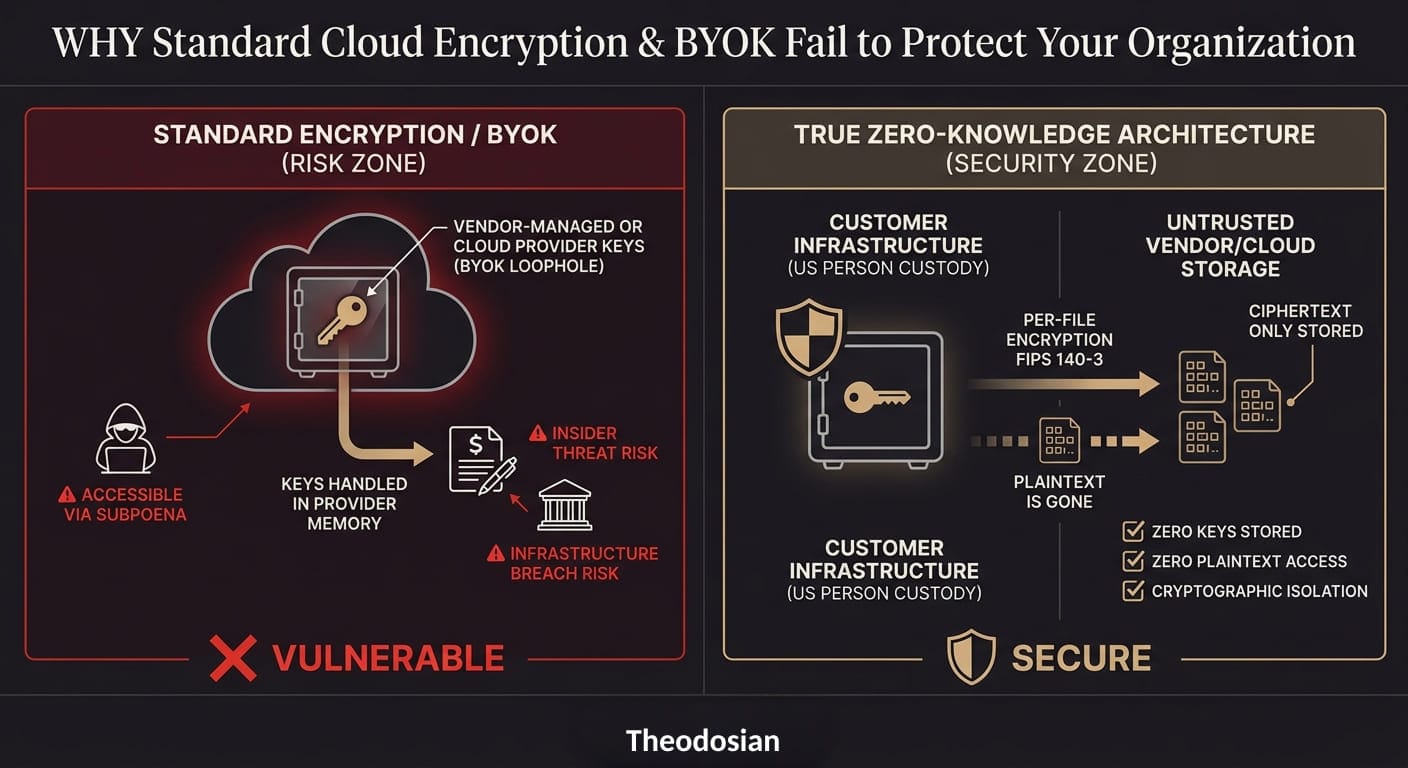
In a standard cloud encryption model, the cloud provider manages encryption keys on behalf of customers. The data is encrypted, but the provider holds the keys. This protects data from external attackers who breach the storage layer without gaining access to the key management system. It does not protect data from:
- The provider's own administrators with legitimate key management access
- A provider-level breach that compromises both encrypted data and key management systems simultaneously
- A government subpoena or court order served to the provider requiring key production
- A foreign authority with jurisdiction over the provider's key management infrastructure
- A provider acquisition or bankruptcy proceeding that changes who controls the keys
For most consumer-grade file storage, these scenarios are theoretical concerns. For an organization handling ITAR technical data, classified-adjacent information, or healthcare records, they are documented compliance risks.
What Is Zero-Knowledge Encryption and How Is It Different?
Zero-knowledge encryption is an architecture in which the service provider has no access to the cryptographic keys required to decrypt customer data — and no ability to acquire that access under any circumstances. "Zero knowledge" refers to the provider's knowledge of the plaintext content: it is zero.
The architecture works as follows: encryption and decryption operations happen on the customer side, under the customer's control. The provider stores or processes ciphertext but never receives the plaintext data or the keys required to produce it. When a user requests access to a protected file, the key is retrieved under the customer's control and used locally — never transmitted to or accessible by the provider's infrastructure.
The practical consequence: a government subpoena served on the zero-knowledge provider yields encrypted ciphertext and no key. The provider genuinely has nothing to produce. A breach of the provider's infrastructure yields the same result. A rogue administrator at the provider has no mechanism to access customer key material.
This is fundamentally different from the standard model where the provider holds keys "on your behalf." That model means the provider is capable of decryption, whether or not they exercise that capability. Zero-knowledge means the capability does not exist on the provider's side.
Why Does Key Control Matter When Your Files Are Already Encrypted?
The answer depends on your threat model. For most commercial applications, vendor-managed keys are a reasonable choice — the practical risk of vendor-side key exposure is low, and the operational convenience of not managing your own key infrastructure is real.
For organizations subject to specific regulatory requirements, the calculation is different.
ITAR: The encryption safe harbor under 22 CFR § 120.54 requires that decryption keys remain under the control of US Persons. "US Person control" means your organization — not your vendor — must hold the keys. A vendor holding keys on your behalf does not satisfy the requirement if that vendor is compelled to produce those keys by a foreign authority with jurisdiction over their infrastructure. Zero-knowledge architecture is the cleanest path to satisfying the key control requirement by design rather than by configuration.
CMMC Level 2: SC.L2-3.13.10 requires that your organization manages its own cryptographic keys protecting CUI. If a vendor controls your keys, they are satisfying the control — not you. A vendor breach or unauthorized key access is an event outside your control. Zero-knowledge architecture means the key management control lives in your organization's hands, not your vendor's.
General enterprise security: Beyond specific regulations, vendor-controlled key management creates a category of risk that zero-knowledge eliminates: the risk that your data is exposed by something that happens at your vendor, not at you. Vendor breaches, insider threats at the vendor, and legal compulsion of the vendor are all scenarios where the data protection fails through no action of your own. Zero-knowledge removes your exposure to that category of risk entirely.
🔒 Are Your Cloud Encryption Keys Truly Out of Vendor Hands?
If your software vendor retains the technical ability to decrypt your files, you don't possess full cryptographic custody. True compliance requires architectural elimination of third-party risk.
What Is the Difference Between Zero-Knowledge Encryption and BYOK?
Bring Your Own Key (BYOK) is a feature offered by many cloud providers that allows customers to provide their own encryption keys, which the provider then uses within their own key management infrastructure. It is sometimes marketed as "customer-managed keys" or "customer-controlled encryption."
BYOK is better than purely vendor-managed keys. But it is not the same as zero-knowledge encryption.
In a BYOK model, the customer provides the key material and the cloud provider uses it within their own systems. The provider's infrastructure still handles the key in the process of encrypting and decrypting data. This means the provider's administrators can still access key material in operation; a breach of the provider's key management infrastructure can expose customer-provided keys, and a legal compulsion served to the provider can potentially cover not just data but key material that passes through their infrastructure.
In a true zero-knowledge architecture, the encryption and decryption operations happen on the customer side. The key never enters the provider's infrastructure in a usable form. The provider genuinely cannot access it.
The test is simple: can the provider decrypt your data if they had to? In a BYOK model, yes — they could access your key during key rotation, under legal compulsion, or through a sophisticated internal breach. In a true zero-knowledge architecture, no — the key never passes through systems they control in a form they can use.
This difference matters significantly for ITAR and CMMC compliance, where the regulatory requirement is that the organization — not the vendor — controls the key.
What Are the Compliance Implications of Zero-Knowledge Encryption?
Three regulatory frameworks where zero-knowledge architecture has specific compliance value:
ITAR (22 CFR § 120.54): The encryption safe harbor requires that decryption keys are under US Person control. True zero-knowledge architecture satisfies this by design — the keys exist only under the customer organization's control, with no path for the vendor to access them. BYOK configurations where the key passes through vendor infrastructure require careful analysis of whether the vendor's key access capability satisfies or undermines the US Person control requirement.
CMMC Level 2 (SC.L2-3.13.10): The control requires organizations to "employ cryptographic mechanisms to protect the confidentiality of CUI during transmission unless otherwise protected by alternative physical safeguards." The sub-practice around key management requires organizational control. Zero-knowledge architecture maps to this control directly.
HIPAA Security Rule (45 CFR § 164.312): The Security Rule's addressable encryption specifications do not require zero-knowledge architecture specifically, but the requirement that covered entities maintain control over their security program — and the OCR enforcement history around vendor-managed security failures — creates a practical argument for key control architectures that keep the accountability inside the covered entity.
How Do You Know If a Platform Is Genuinely Zero-Knowledge?
The marketing language around zero-knowledge is imprecise. Vendors use the term to describe a range of implementations, some of which are genuinely zero-knowledge and some of which are BYOK with zero-knowledge branding.
Questions to ask any vendor claiming zero-knowledge architecture:
Can you decrypt our data if served with a court order? The honest answer for a genuine zero-knowledge system is: no. If the vendor hedges or says "we would notify you first," that is not zero-knowledge — they retain the capability to decrypt.
Where does the encryption operation happen, on our infrastructure or yours? In zero-knowledge architecture, encryption and decryption happen on the customer side. If the vendor answers "on our servers" or "in our cloud environment," the key is accessible to their infrastructure at some point.
Does our key material ever pass through your systems in a usable form? Again, the answer for genuine zero-knowledge should be no. Key material in a zero-knowledge system exists only under the customer's control.
What happens to our keys if you are acquired or go bankrupt? Zero-knowledge architecture means the answer is "nothing — we never had access to your keys." If the vendor describes a key transfer process, the keys were under their control.
Theodosian's patent-pending architecture implements zero-knowledge key management: your organization controls decryption keys, and Theodosian cannot access them under any circumstances. This is how SC.L2-3.13.10 and ITAR's US Person key control requirement are satisfied architecturally — not through policy or contractual assurance — but by design.
📋 Navigating Strict Key Custody Frameworks?
Whether you are actively addressing the strict data sovereignty parameters of ITAR, CMMC Level 2, or HIPAA, checking a compliance box isn't enough; you have to prove total organizational key control.
FAQs: Zero-Knowledge Architectures
What is zero-knowledge encryption in simple terms?
Zero-knowledge encryption means the company providing your file storage or security service cannot read your files — even if they want to, are hacked, or are ordered to by a court. The encryption keys that unlock your files exist only under your organization's control. The service provider stores or processes encrypted data but has no ability to decrypt it. This is different from standard cloud encryption, where the provider manages the keys on your behalf and could technically access your data under certain circumstances.
Is BYOK the same as zero-knowledge encryption?
No. Bring Your Own Key (BYOK) means you provide your encryption key to the service provider, who then uses it within their own infrastructure. The provider's systems still handle your key in operation, which means they technically have access to it, even if they do not use that access routinely. In a true zero-knowledge system, encryption and decryption happen on your side, and your key material never passes through the provider's infrastructure in a form they can use. BYOK improves on purely vendor-managed keys but does not provide the same guarantee as zero-knowledge architecture.
Does zero-knowledge encryption satisfy ITAR key control requirements?
Yes, when implemented correctly. The ITAR encryption safe harbor under 22 CFR § 120.54 requires that decryption keys remain under US Person control. A zero-knowledge architecture in which your organization holds the keys and the vendor cannot access them satisfies this requirement by design. Standard BYOK configurations, where the key passes through vendor infrastructure, require careful analysis of whether the vendor's access capability undermines the US Person control condition. When evaluating ITAR compliance for any encryption solution, confirm whether the vendor can technically access your key material, not just whether they have a policy saying they will not.
What is the difference between zero-knowledge encryption and end-to-end encryption?
End-to-end encryption (E2EE) means data is encrypted at the sender's end and decrypted only at the intended recipient's end — no intermediate party can read it in transit. Zero-knowledge encryption focuses specifically on the service provider's inability to access the key material. The two concepts overlap significantly and are often implemented together: a zero-knowledge file security platform encrypts files before they reach the provider's infrastructure (like E2EE) and manages keys in a way that the provider cannot access them (zero-knowledge). For enterprise file security, you want both: encryption that covers transit and the guarantee that the provider holds no key.