
When companies build powerfual technology, the U.S. government wants to ensure it doesn’t end up in the wrong hands. That’s where export controls come in.
Most organizations are familiar with ITAR. Far fewer fully understand EAR, even though EAR applies to significantly more businesses, often without them realizing it.
EAR compliance isn’t purely about shipping products overseas. It governs how technology, software, and technical data are accessed, stored, and shared, even inside your own organization.
What Is Export Administration Regulations (EAR)?
EAR stands for Export Administration Regulations. It’s enforced by the U.S. Department of Commerce’s Bureau of Industry and Security (BIS).
Unlike ITAR, which focuses narrowly on defense and military items, EAR regulates a much broader category of commercial and “dual-use” technology; products that are primarily civilian but could also have military, intelligence, or strategic applications.
Think:
- Advanced electronics
- High-performance computing components
- Engineering software
- Materials, sensors, and technical designs
If your product is “smart,” powerful, or reusable beyond a single civilian purpose, there’s a good chance EAR applies.
🛡️ Is Your Data EAR Compliant?
Cloud providers don't manage your export risks; you do. See how Theodosian automates access control for EAR-controlled data.
Who Does EAR Compliance Apply To?
EAR applies to:
- U.S. companies exporting technology, software, or technical data
- Foreign companies handling U.S.-origin controlled technology
- Cloud, SaaS, and remote teams accessing controlled files
- Organizations with international employees or contractors
Crucially, EAR doesn’t only regulate where data goes, it regulates who can access it. That’s where many organizations get caught off guard.
EAR Compliance Is Not “Lighter ITAR”
A common misconception is that EAR is simply a more relaxed version of ITAR. In reality, EAR is more nuanced, not less serious.
Under EAR:
- Some exports require licenses
- Some are permitted depending on the country and end use
- Some are prohibited entirely
Classification matters. Country matters. User identity matters.
Misclassifying data or failing to control access may trigger a violation without ever shipping a product.
If you’re unsure whether your data falls under EAR or ITAR, understanding the distinction is critical. We break that down in our guide on EAR vs ITAR compliance differences.
Why EAR Compliance Is a Modern Security Problem
EAR was written long before cloud storage, global collaboration tools, and hybrid workforces became standard. But it still applies fully to modern environments.
That means:
- A shared cloud drive can be an export
- An email attachment can be an export
- Granting file access to the wrong user can be an export
Compliance today isn’t about shipping boxes; it’s about controlling digital access.
What EAR Looks Like in Practice
To stay compliant, organizations must:
- Identify which files contain EAR-controlled data
- Restrict access based on user attributes, not just job roles
- Maintain detailed access logs
- Prove ongoing enforcement, not one-time controls
This is why more security teams are shifting toward data-centric security models, where protection travels with the file itself, not just the network it sits on.
In a modern environment, EAR compliance is less about perimeter defense and more about persistent data protection. We explore how to implement that in practice in our guide to managing EAR-controlled data across cloud and remote teams.
🔒 Start Proving Compliance!
From Export Administration Regulations to ITAR, Theodosian ensures your encryption follows the file. Meet EAR compliance standards with a single source of truth for your auditors.
FAQs: Export Administration Regulations (EAR)
How does "Deemed Export" affect EAR compliance?
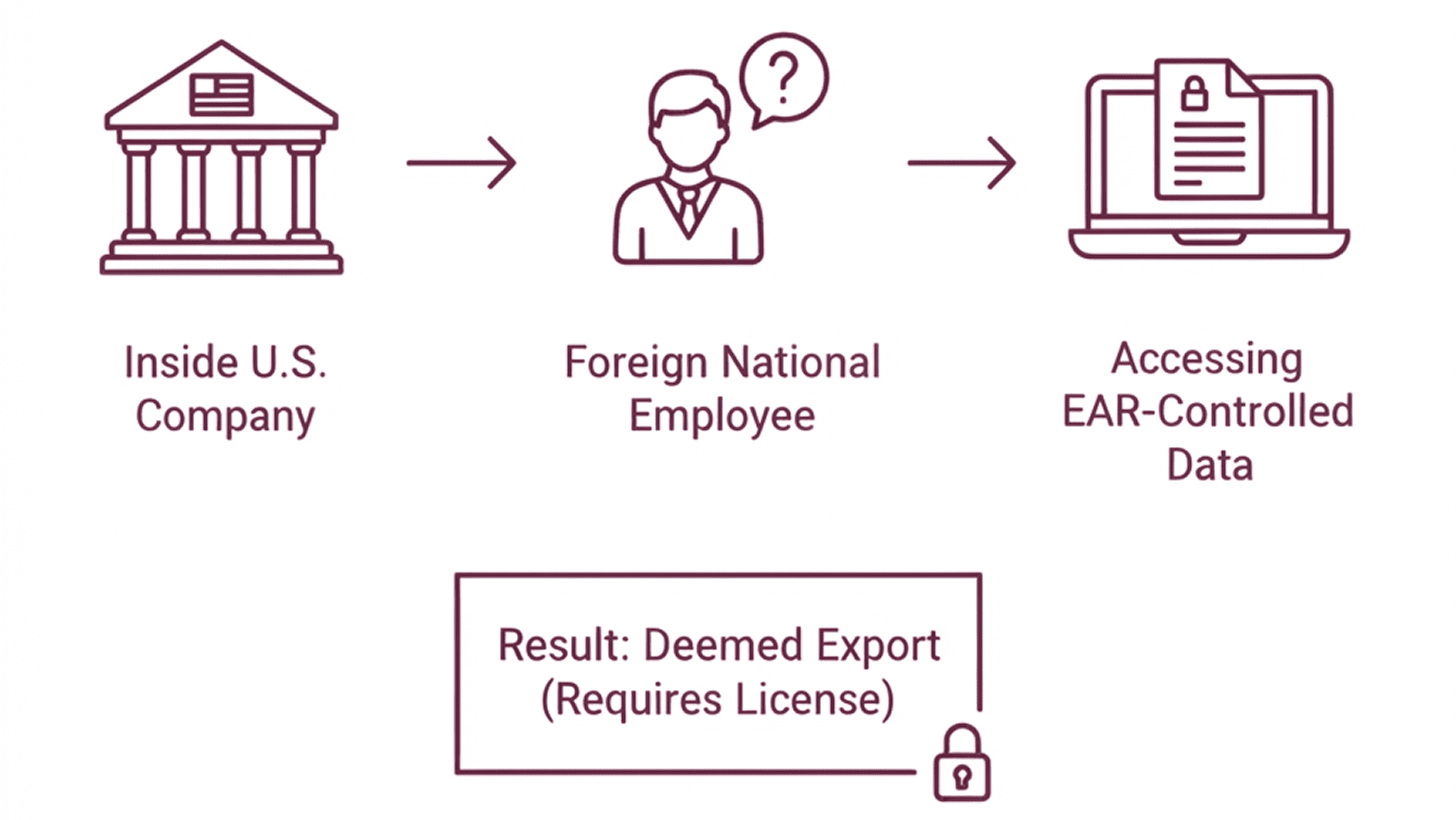
A "Deemed Export" occurs when technical data is released to a foreign national within the United States. Even if the data never leaves your office or your cloud server, allowing an unauthorized foreign person to view EAR-controlled data is considered an export and requires a license.
Does EAR only apply to companies that export products overseas?
No. This is one of the most common misconceptions. EAR applies to digital access, not just physical exports. If controlled technology is accessed by a foreign national — even inside the U.S. or through cloud storage — that can count as an export under EAR.
What types of technology are regulated under EAR?
EAR typically covers commercial and dual-use technology, including:
- Software and source code
- Engineering designs and technical documentation
- Electronics, sensors, and advanced materials
- High-performance computing and networking technology
If a product has both civilian and potential military or strategic uses, it may fall under EAR.
Does EAR apply to cloud storage and SaaS platforms?
Yes. If EAR-controlled data is stored in the cloud, organizations must ensure:
- Data location and sovereignty requirements are met
- Access is restricted to authorized users
- Cloud providers do not have uncontrolled access to the data
Cloud storage does not remove export control obligations.
Do small and mid-sized businesses need to worry about EAR?
Yes. EAR applies regardless of company size. Many small and mid-sized organizations fall under EAR because they develop:
- Software
- Hardware
- Technical services
- Engineering or R&D capabilities
Lack of awareness does not reduce liability.