
Most access control systems answer one question: does this person have the right role?
A finance analyst has the Finance role. The Finance role has read access to the budget folder. The analyst opens the budget file. Access granted.
That logic works fine when the threat is an unauthorized outsider. It breaks down the moment the threat is an authorized insider acting outside normal patterns, a legitimate account whose credentials have been compromised, or a contractor accessing sensitive files from an environment nobody expected.
Role-based access control answers "who are you?" Dynamic access control asks a harder question: "given everything I know about this request right now, should I grant access?"
What Is Role-Based Access Control and Where Does It Fall Short?
Role-based access control (RBAC) assigns permissions based on a user's role within an organization. An employee's access to systems and files is determined by their job function — Finance reads financial data, Engineering reads engineering files, HR reads personnel records. It is clean, manageable, and widely implemented.
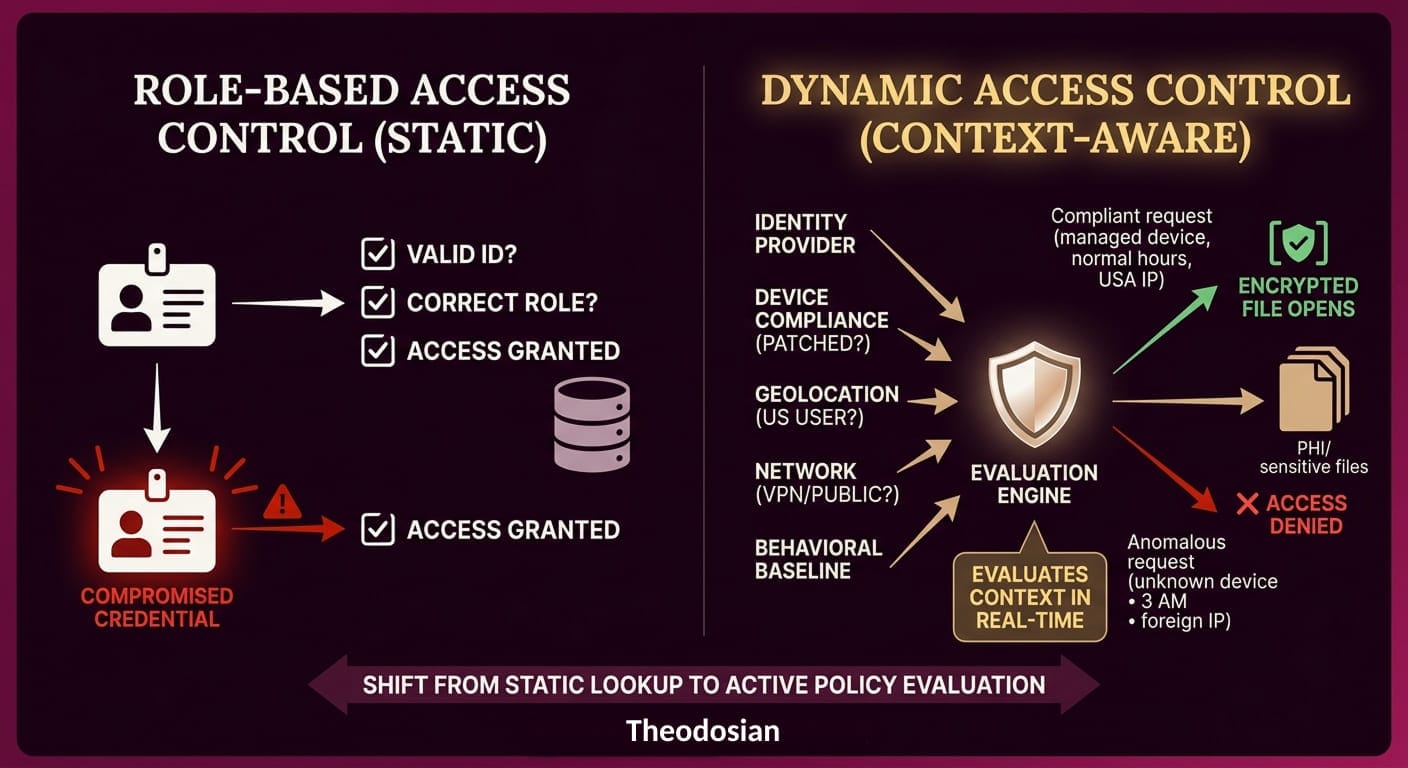
The fundamental limitation of RBAC is that it is static. Once a role has been assigned and permissions have been configured, the system has nothing more to say. The same analyst who should be accessing budget files during business hours from a managed laptop is indistinguishable from an attacker who stole that analyst's credentials and is accessing those same files at 2 am from a hotel in an unexpected country.
The role check passes in both cases, but the context is completely different. RBAC has no mechanism to evaluate context.
There are three specific scenarios where static, role-based access control consistently fails:
Compromised credentials. Stolen credentials satisfy RBAC checks. The attacker presents a valid identity with the correct role. Nothing about the role assignment has changed. Access is granted. The compromise is invisible at the access control layer.
Over-provisioned access. In practice, access permissions expand over time. Employees change roles, join projects, and accumulate access that never gets revoked. An RBAC system can be technically correct — everyone has a role — while being practically dangerous because those roles grant far more access than current job functions require.
Context-blind decisions. A user accessing files from a compliant corporate device during normal hours is doing something different from the same user accessing the same files from a personal device on a public network at midnight. RBAC cannot distinguish between these scenarios. Both get the same access decision.
🔒 Is Static Access Leaving You Vulnerable to Credential Theft?
If an attacker compromises a valid corporate identity, traditional RBAC welcomes them right through the front door. True data security requires real-time contextual validation.
What Is Dynamic Access Control and How Does It Work?
Dynamic access control (DAC) — sometimes called attribute-based access control (ABAC) or context-aware access control — evaluates multiple signals simultaneously at the moment of each access request. Rather than asking only "does this identity have the right role?", it asks: "does the totality of context around this request justify granting access?"
The signals evaluated vary by implementation, but a mature dynamic access control system considers some combination of:
- Identity: Who is making the request, verified against an authoritative identity provider
- Device: What device is the request coming from? Is it managed and compliant?
- Location: Where is the request originating? Is the location consistent with this user's normal pattern?
- Network: Is the request from a corporate network, VPN, or unknown public network?
- Time: Is this happening during normal working hours for this user?
- Behavior: Is the volume and pattern of access consistent with how this user normally behaves?
Each signal is evaluated in real time at the point of the access request. The access decision is not a lookup against a static permission table — it is a policy evaluation against current conditions.
The practical consequence: the same user with the same role and the same valid credentials can receive different access decisions depending on the context of their request. A compliant device on a corporate network during business hours gets access. The same identity on an unknown device from an unexpected geography at 3am gets denied, or stepped up to additional verification.
What Signals Should a Dynamic Access Control System Evaluate?
The value of a dynamic access control system scales with the richness of the signals it can evaluate. A system that only adds time-of-day checks to an RBAC model is better than pure RBAC, but it is not the same as a system that evaluates six or seven independent signals simultaneously.
The most informative signals for an enterprise environment:
Device identity and compliance status. Not just "is the user authenticated" but "is this the device this user normally uses, and is that device currently meeting compliance requirements — patched, encrypted, endpoint security running?" A valid identity on a non-compliant or unknown device is a materially different risk profile from the same identity on a known managed device.
Geographic and IP context. Where is the request originating? A user who consistently accesses files from one city and suddenly makes a request from a different country — while their normal device is still active in the expected location — is exhibiting a signal consistent with credential compromise. This is a common indicator in account takeover attacks.
Network type. Corporate network, known VPN, or unknown public network? Access from a public coffee shop Wi-Fi carries a different risk profile from access on a corporate LAN, even with the same identity credentials.
Temporal patterns. What time is it, and is that consistent with how this user normally works? Combined with geographic signals, off-hours access from unexpected locations is one of the highest-confidence anomaly indicators available.
Access volume and rate. Is this user accessing one file — normal work behavior — or 500 files in a 10-minute window? Bulk access is the behavioral fingerprint of exfiltration attempts, whether by an external attacker or a departing insider.
Behavioral baseline deviation. Taken together, does the current session resemble what this user normally does? File types accessed, directories visited, session duration — machine-learning-based behavioral baselines can detect patterns that static rules miss.
What Is the Difference Between Network-Level and File-Level Dynamic Access Control?
Dynamic access control can be implemented at the network or application layer — controlling who can connect to which systems — or at the file layer, where access controls are embedded in individual files and evaluated on every access request regardless of environment.
Network-level dynamic access control (the approach used in most zero-trust network access implementations) controls access to systems and applications. It evaluates context at the point of network connection and determines whether a user's device can reach a particular resource. This is a meaningful improvement over flat-network architectures.
The limitation appears when files move outside the network perimeter: downloaded to endpoints, shared with external parties, emailed to partners. Once a file leaves the network environment, the network-layer access controls have no further say about who can open it.
File-level dynamic access control embeds the policy in the file itself. Every access request — whether the file is on a corporate SharePoint, on an engineer's local drive, or in a shared folder at a subcontractor's office — is evaluated against the same policy. The file carries its access control logic into every environment it enters.
For organizations whose sensitive files routinely leave their primary environment. The zero-trust network controls the gate. File-level dynamic access control follows the file through the gate and beyond.
What Does Dynamic Access Control Look Like?
A practical implementation at the file layer evaluates the access signals above on every file open event and produces one of three outcomes: access granted, access denied, or step-up verification required.
Theodosian implements this model with context-aware access controls that evaluate identity, device compliance status, location (IP, GPS, and country), network type, time of access, and behavioral anomaly signals on every access request to a protected file. The evaluation happens in real time regardless of which platform the file is on.
When signals are consistent with authorized access — known identity, managed device, expected location, normal hours, typical access pattern — the file opens. When signals are anomalous, the response is proportionate: unusual device triggers step-up MFA; unexpected geographic origin combined with off-hours timing triggers access denial; bulk access patterns trigger Drop the Gate, which freezes access to protected files, requires step-up verification, and notifies the security team immediately.
The entire access event is logged: identity, device, location, network, time, access outcome, and any anomaly detected. That log exists regardless of which environment the file is in at the time of access, making it useful for compliance purposes as well as incident investigation.
This is what dynamic access control looks like applied at the layer where the data actually lives.
Which Organizations Benefit Most from Dynamic Access Control?
Organizations where sensitive files regularly leave a single controlled environment — which, in practice, is most mid-sized and enterprise organizations.
The benefit is sharpest in four contexts:
Distributed or remote workforces. Users accessing sensitive files from home networks, coworking spaces, and personal devices create exactly the context diversity that static RBAC cannot handle. Dynamic access control evaluates the actual context of each access event rather than assuming all access from a valid credential is equivalent.
Defense and regulated industries. CMMC Level 2's access control requirements (AC.L2-3.1.1, AC.L2-3.1.2) describe least-privilege, need-to-know access that dynamic access control implements more precisely than static roles. ITAR's US Person requirements create a context that needs to be evaluated at the point of access, not just at user provisioning.
Organizations managing third-party access. Contractors, partners, and vendors with legitimate access to sensitive files are a common source of exposure. Dynamic access control can apply stricter policies to third-party identities — requiring managed devices, limiting access hours, restricting geographic access — without requiring different file versions or manual access revocation.
Post-merger or post-acquisition environments. Access governance during integration is notoriously complex. Dynamic access control evaluates current context rather than inherited role structures, providing a security layer that operates independently of whether permissions have been cleaned up yet.
🛡️ Stop Granting Blind Access to Your Most Sensitive Files
A user's role shouldn't give them a blanket pass to download data at 3 AM from an unknown device. With Theodosian, policies travel directly within the file layer, evaluating risk dynamically on every single click.
FAQs: Dynamic Access Control
What is the difference between RBAC and dynamic access control?
Role-based access control (RBAC) assigns permissions based on a user's organizational role and evaluates access using a static permission table — if the identity has the right role, access is granted. Dynamic access control evaluates multiple contextual signals in real time at the moment of each access request: identity, device compliance, location, network type, time, and behavioral patterns. The key difference is that dynamic access control can deny access to a user with the correct role if their current context is anomalous, while RBAC cannot. Dynamic access control is particularly effective against credential-based attacks, where an attacker presents valid credentials but operates in a different context from the legitimate user.
Does dynamic access control replace multi-factor authentication?
No — dynamic access control and MFA address different layers of the access security problem. MFA verifies that the person presenting credentials is in possession of a second factor (a phone, a hardware token, a biometric). Dynamic access control evaluates whether the overall context of the access request is consistent with authorized access, beyond just identity verification. A well-designed implementation uses MFA as an input to dynamic access control — a user who has completed MFA but is accessing from an anomalous context may still be denied or stepped up to a higher verification requirement. The two controls are complementary.
How does dynamic access control relate to zero trust?
Zero trust is an architectural philosophy: never trust, always verify, assume breach. Dynamic access control is one of the key technical implementations of that philosophy at the access layer. Zero trust applied to network access means continuous verification of identity and device before granting system access. Zero trust applied to file access means evaluating every access request against current context — not trusting that a previous authentication event justifies ongoing file access. Dynamic access control at the file layer is zero trust applied to the data itself.