
Ask a security team what their biggest fear is, and most will say a sophisticated external attacker. The organised criminal group. The nation-state. The zero-day.
The data tells a different story.
According to the Verizon Data Breach Investigations Report, the human element—ranging from malicious insiders to stolen or phished credentials—is involved in 62% of all data breaches. The threat that keeps security teams up at night is, statistically, already inside the building — with a badge, a valid login, and every right to be there.
Understanding what an insider threat actually is, and more importantly, why the standard response to it doesn't work, is one of the more useful things a security leader can do right now.
What Is an Insider Threat?
An insider threat is any security risk that originates from within your organization — current employees, former employees, contractors, business partners, or anyone else who has legitimate access to your systems, networks, or data.
The term covers a wider range than most people realize. It's not just the disgruntled employee who steals files on their way out the door. It includes:
- The well-meaning engineer who emails a sensitive file to a personal account because the VPN is slow.
- The contractor whose credentials get phished, giving an external attacker an internal footprint.
- The finance director who shares a budget spreadsheet with a consultant via a personal Dropbox.
- The system administrator who exports customer records before handing in their notice.
What unites all of these? The activity looks authorized. To most security tools, it is authorized.
🔒 Can You Stop Data Exfiltration Before It Leaves the Endpoint?
If an employee has a legitimate login, your monitoring tools will let them download files all day long. Detection only alerts you after the damage is done. True prevention requires data that protects itself.
What Does an Insider Threat Look Like?
Insider threats don't behave like external attacks. There's no lateral movement to detect. No privilege escalation alert. No anomalous login from an unfamiliar country.
A cleared engineer with access to a program file share downloads 40 files on a Friday afternoon. Is that a threat? Maybe. Maybe it's just end-of-week admin. Your SIEM doesn't know either.
A customer success manager exports the full client list to a personal Google Sheet "for easier formatting." Three months later, she joins a competitor. How much of that data traveled with her?
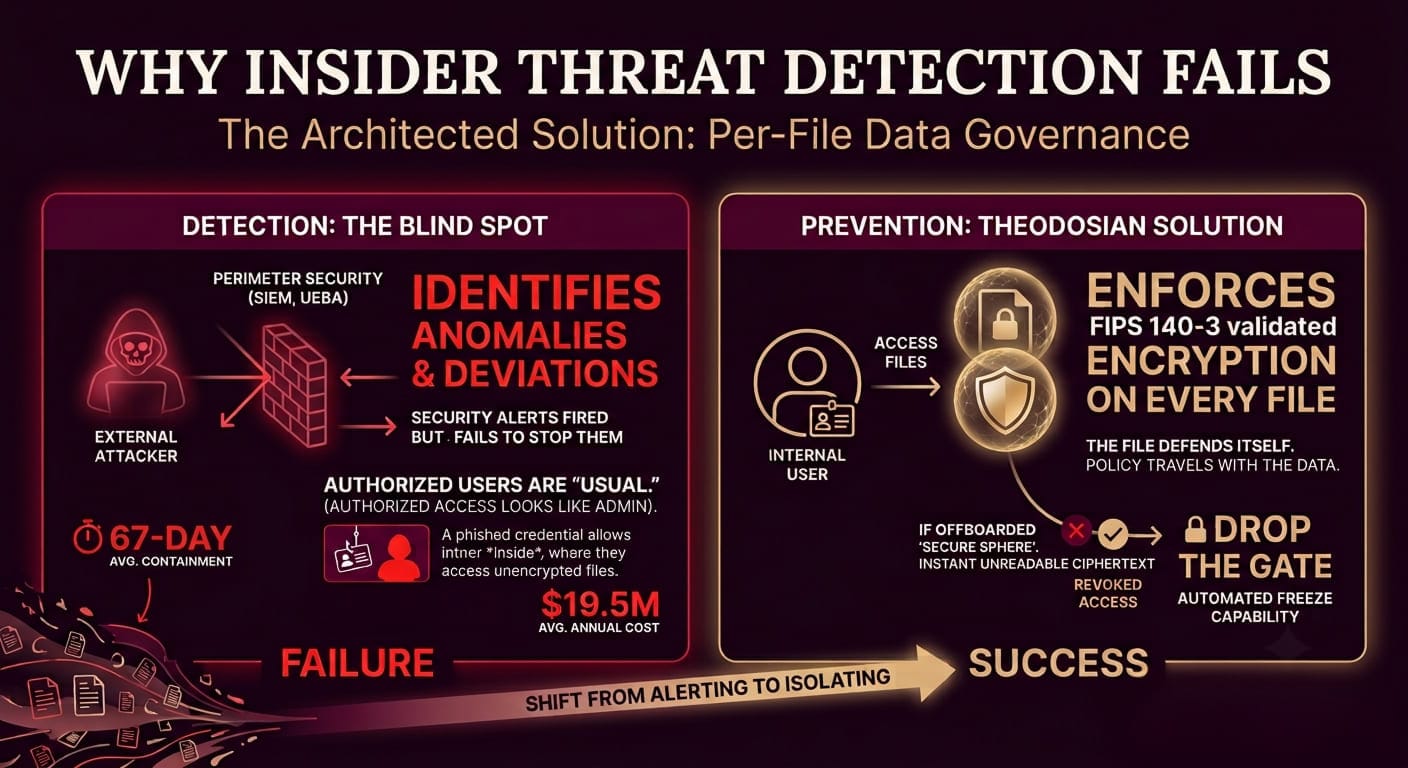
The latest Ponemon Institute Global Cost of Insider Risks Report shows that routine insider activity now costs the average organization a staggering $19.5 million annually. When containment takes longer than 90 days, those costs balloon to an average of $21.9 million per incident. These aren't edge cases anymore; even with massive budget increases, it still takes organizations an average of 67 days just to contain an internal threat.
Why Is Insider Threat Detection So Difficult?
Because authorized behavior and malicious behavior look identical at the access layer.
Your SIEM is built to flag anomalies against a baseline. If the baseline for a program manager includes daily file downloads, that behavior won't fire an alert, even if the content of those downloads changes completely. Detection tools are calibrated for what's unusual. Insiders with legitimate roles are, by definition, usual.
User and Entity Behavior Analytics (UEBA) tools help — they can flag statistical deviations, unusual hours, bulk downloads. But they operate on probability, not certainty. A 40-file export on a Friday triggers a low-severity alert that gets triaged on Monday morning, after the employee has already had access to the file.
The detection problem isn't solvable by adding more detection. It's a structural limitation of the model.
Can Your SIEM Catch an Authorized User Doing Unauthorized Things?
Not reliably. And this is the piece most security programs don't say out loud.
A SIEM can catch the access event. It can log who opened a file, at what time, from what device. What it cannot tell you is whether that access was legitimate or the beginning of an exfiltration — not without a rule or a behavioral model that's already been tuned to that exact pattern.
The 241-day average breach lifecycle documented in the IBM Cost of a Data Breach Report reflects this reality. For insider threats, the number is often longer — because the behavior pattern doesn't look like a breach at all until after the fact.
That's not a failure of your security team. That's the limit of what detection-first architectures can do against an authorized identity.
What Actually Stops an Insider Threat at the File Level?
If detection can't reliably catch authorized insiders before damage is done, the only control that consistently works is one that doesn't rely on catching them.
Per-file access controls — where each file carries its own encryption and policy, independent of the container it lives in — change the architecture of the problem.
Container-based security says: "This user has access to this SharePoint library." Per-file security says: "This user has access to this specific file, in this context, right now." Those are very different threat models.
With per-file controls in place:
- A bulk download doesn't give the insider an unencrypted copy — they get files that are still access-controlled by the originating system.
- When an employee is terminated, their access is revoked at the file level — even for files already on their personal device or cloud sync.
- Every access event — who opened a specific file, when, from what device — is logged individually, not buried in aggregate system events.
The file defends itself. That's not a metaphor; it's the architectural shift that makes insider threat prevention a design outcome rather than a detection challenge.
How Does Theodosian Address Insider Threats?
Theodosian applies per-file encryption and context-aware access controls to every file it protects. Encryption is FIPS 140-3 validated — each file gets its own cryptographic key, not a shared volume key that an insider with system access could potentially reach.
Access policies travel with the file. If a user downloads a sensitive document to their personal laptop, the file doesn't become uncontrolled — it remains subject to the real-time access policy set by the originating organization. If that access is revoked after offboarding, the file becomes inaccessible to the former employee, regardless of where it is.
Drop the Gate, Theodosian's autonomous threat response capability, monitors per-file access patterns and can freeze access automatically when behavior deviates from established norms — creating an audit trail at the exact moment the anomaly occurs, not 67 days later.
The audit log is per-file, per-user, per-action. When an assessor — or an incident responder — asks "who accessed this specific file over the last 90 days and what did they do with it," the answer is immediately queryable.
🛡️ Take the Leverage Away from Stolen Credentials
You cannot perfectly predict human behavior, nor can you catch every phished credential. But you can ensure that even if an insider copies a file to a personal device, they cannot open it without real-time authorization.
FAQs: Insider Threats & File-Layer Security
Why do traditional Data Loss Prevention (DLP) tools fail to stop sophisticated insider threats?
Traditional DLP tools rely on rules, signatures, and network perimeters (e.g., blocking USB drives or flagging specific keywords). Sophisticated or privileged insiders easily bypass these controls by changing file extensions, taking screenshots, printing hard copies, or simply sharing data through approved, collaborative cloud tools like SharePoint or Slack. Because DLP checks the data only at the boundary, it cannot stop an insider who has legitimate access from misusing the file once it is inside their approved workspace.
If an employee downloads an encrypted file to a personal device and then leaves the company, how does the file remain secure?
With Theodosian's per-file encryption, the cryptographic keys do not live on the user's device or within the file container; they reside securely within our central access management layer. Every single time a user attempts to open the file, a real-time policy check occurs. The moment that employee is offboarded and their identity is deactivated in your central directory, the file immediately loses its validation pathway. Even if it sits on a personal hard drive forever, it becomes permanently unreadable.
Does file-level encryption heavily disrupt everyday workflows for standard, non-malicious employees?
No. Theodosian is designed to operate seamlessly within the user's normal application workflow. For everyday employees performing authorized actions under standard conditions, the decryption and access verification happen instantly in the background. The security controls only inject friction or freeze access (via Drop the Gate) when anomalous, high-risk behavior patterns occur—such as bulk rapid downloads or unauthorized credential sharing—ensuring productivity stays high while risk is mitigated.