
Most organizations now have an AI governance policy. It defines acceptable use, assigns a governance committee, sets review cadences, and references whatever framework the legal team chose — NIST AI RMF, ISO/IEC 42001, the EU AI Act.
What most AI governance policies don't specify is who enforces the controls at the actual data layer — on the files that AI systems access, train on, generate, and share.
That's not a drafting oversight. Governance frameworks describe obligations. They don't install controls. The question AI governance creates — "who can access which data, under what conditions, with what auditability?" — is a file-layer question. And most organizations have answered it with a policy document instead of a technical control.
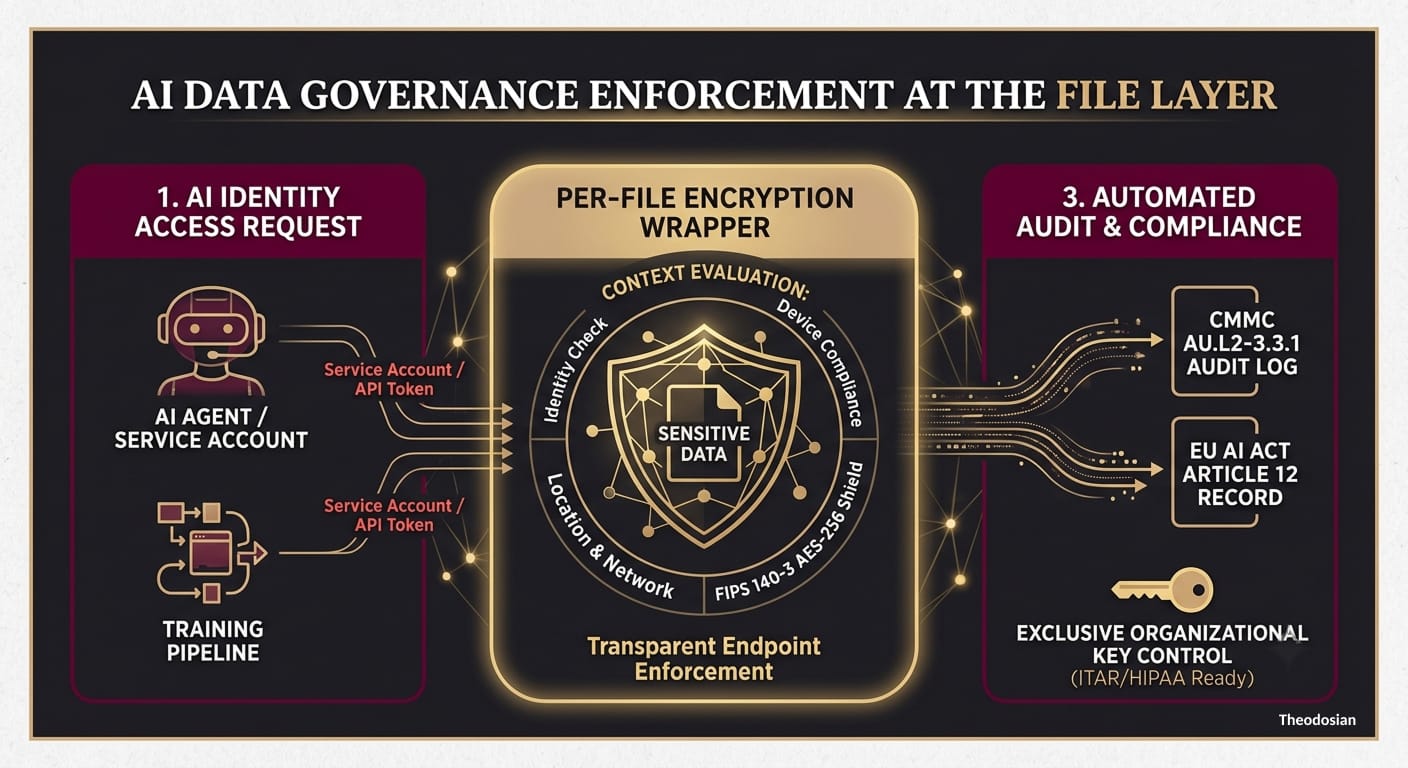
What Is AI Data Governance, and Why Does It Involve File Security?
AI data governance is the set of policies, processes, and controls that determine how data is collected, stored, accessed, and used by AI systems. It covers training data, inference inputs, model outputs, and the audit trail connecting decisions to the data that produced them.
The governance question sounds administrative. The technical requirement is not.
When an AI system accesses files — documents in SharePoint, patient records in an EHR, engineering schematics in a shared drive, contract terms in a legal vault — it's accessing the same regulated data that your compliance program already governs. ITAR-controlled technical data doesn't stop being ITAR-controlled because an AI agent is reading it. HIPAA-protected ePHI doesn't stop requiring access controls because the requestor is an automated workflow rather than a clinician.
The access control, audit logging, and encryption requirements that apply to human access to regulated files apply equally to AI access. Governance frameworks are increasingly explicit about this. The technical gap is that most file security implementations were built for human authentication flows — and AI agents, automated pipelines, and non-human identities bypass those flows entirely.
🤖 Extend File-Layer Protection to Non-Human Identities
Stop letting automated pipelines and AI agents bypass your security perimeter. Discover how per-file encryption and context-aware access policies enforce compliance across every identity.
What Do AI Governance Frameworks Specifically Require for Data Protection?
Three frameworks with current enforcement relevance make the strongest technical demands on how organizations protect the data AI touches:
NIST AI RMF (AI Risk Management Framework): The Map, Measure, and Manage functions explicitly require organizations to identify data provenance, assess data quality and integrity, and implement controls that prevent unauthorized access or modification of data used by AI systems. NIST AI RMF 1.0 emphasizes accountability for data throughout the AI lifecycle — including training, fine-tuning, and inference. Technical controls that enforce access policy and generate audit trails are the implementation layer this framework requires.
EU AI Act (Regulation 2024/1689): In effect for high-risk AI systems, Article 10 requires "data governance and management practices" including measures to ensure data sets are "free of errors and complete" and subject to access controls appropriate to their sensitivity. Article 12 requires "record-keeping" sufficient to allow regulators to reconstruct how decisions were made. For organizations handling data classified as sensitive — health data, biometric data, data concerning criminal convictions — the technical control requirements are specific and auditable.
CMMC Level 2 / NIST SP 800-171: For defense contractors using AI to process or analyze CUI, the existing AC and AU domain requirements apply directly. AC.L2-3.1.1 limits system access to authorized users — which includes AI agents. AU.L2-3.3.1 requires audit logs capturing user identity, event type, date, time, and success/failure for every access event. "User" is not defined as human. An AI agent accessing a CUI file triggers the same logging requirement as a cleared engineer.
Where Does AI Data Governance Break Down?
The gap isn't intent. Organizations that have built AI governance programs have genuinely thought about what data AI should and shouldn't access. The gap is enforcement — specifically, what happens to files once they're outside the perimeter that the governance policy describes.
Training data that exits the governed environment: A model fine-tuned on internal documents may have those documents cached in model weights or accessible through retrieval-augmented generation. The file-level controls on the source documents don't automatically extend to the training pipeline.
AI agents with over-permissioned access: Agentic AI systems are increasingly granted broad access to file systems, cloud storage, and APIs. When access permissions are assigned at the folder or system level rather than the file level, an AI agent inherits access to every file in that scope — regardless of classification, sensitivity, or whether that file falls within the intended task.
No audit trail for AI access events: Most cloud storage platforms log human access through SSO and RBAC. AI agents, automated workflows, and service accounts authenticate differently. The audit trail that exists for human access often doesn't extend to non-human identities in a form that satisfies AU.L2-3.3.1 or EU AI Act Article 12.
Files generated by AI that inherit regulated status: An AI system that synthesizes a document from ITAR-controlled technical data produces a derivative work that may itself be ITAR-controlled. If the output file isn't encrypted and access-controlled at the file layer, the governance obligation was created and immediately violated.
How Do Leading AI Governance and Data Security Tools Address File-Layer Control?
| Tool / Platform | Primary Function | File-Layer Control | AI Agent Audit Trail | After-Download Protection |
|---|---|---|---|---|
| Microsoft Purview | Data governance, classification, sensitivity labels | Within M365 ecosystem | Partial — M365 audit logs | ❌ Files outside M365 |
| OneTrust | AI governance program management, risk assessments | ❌ Policy layer only | ❌ | ❌ |
| Varonis | DSPM — discovers sensitive data, detects anomalies | Detection only, no enforcement | Partial — platform-level | ❌ |
| Cyera** | DSPM — AI-powered data discovery and classification | Detection only, no enforcement | ❌ | ❌ |
| Theodosian | Per-file encryption + context-aware access controls | ✅ File layer — travels with data | ✅ Per-access, including non-human identities | ✅ Across all platforms and endpoints |
The tools above the last row are not inadequate; they're doing their jobs. Purview classifies and labels. Varonis and Cyera discover and alert. OneTrust manages the governance program. None of them enforce access policy at the point of the file open event for AI agents operating outside those platforms' native environments.
Theodosian's context-aware access controls evaluate every access request — including requests from non-human identities — against a real-time policy that covers identity (human or service account), device compliance, location, network, time, and behavioral signals. The evaluation happens at the file layer, not the platform layer. A file accessed by an AI agent in a production pipeline generates the same audit log record as a file accessed by an engineer in SharePoint: user identity, file name and classification, device, timestamp, location, network type, and policy outcome.
What Does the EU AI Act Require for Data Security in High-Risk AI Systems?
The EU AI Act categorizes AI systems by risk level. High-risk systems — those used in critical infrastructure, employment, essential services, or that process biometric data — face specific technical requirements for the data they use.
Article 10 requires that training, validation, and testing data sets be subject to "appropriate data governance and management practices," including measures to examine data for potential biases, errors, and gaps. For data that is sensitive under GDPR or sector-specific regulations, this requires demonstrable controls over who can access the data, under what conditions, and with what record of that access.
Article 12 requires "automatic recording of events" sufficient to enable post-hoc review of the AI system's operation. For systems processing regulated files, this means the audit trail must extend to the file access level — not just to the AI system's inputs and outputs at the application layer.
Organizations subject to the EU AI Act that also operate under CMMC, ITAR, or HIPAA face overlapping requirements that all converge on the same technical control: file-layer audit logging that follows the data, not the platform.
The practical implication: if your AI governance policy references the EU AI Act or NIST AI RMF, your technical controls need to implement what those frameworks require — not just document that you've read them.
📊 Audit Every AI File Access Event Automatically
Turn regulatory requirements into automated technical controls. Capture identity, device compliance, location, and policy outcomes for every file accessed by human or AI identities.
Related Reading:
- How Do You Protect the Files Feeding Your AI Systems?
- Shadow AI Data Governance: The Hidden Pipeline Your Security Stack Was Never Built to See
- Data Sovereignty in the Age of AI: How Global Teams Keep Sensitive Files Under Their Jurisdiction
- Agentic AI Security: The Agentic AI Governance Gap
- What Is Data-Centric Security? (And Why Perimeter Security Keeps Breaking)
FAQs: AI Data Governance & File-Layer Security
What is the difference between AI governance and AI data governance?
AI governance is the broader discipline — the policies, oversight structures, accountability frameworks, and ethical guidelines that determine how an organization develops, deploys, and monitors AI systems. AI data governance is a subset focused specifically on the data those AI systems use: how it's collected, classified, protected, audited, and retained. Most AI governance programs have strong process coverage and weak technical controls at the data layer. A governance committee can approve which AI tools are acceptable. It cannot, by itself, enforce that only authorized identities access the files those tools process — that requires a technical control at the file layer.
Does the EU AI Act apply to US companies?
The EU AI Act applies to any organization placing an AI system on the EU market or using an AI system that affects EU-based individuals — regardless of where the organization is headquartered. A US defense contractor whose AI-assisted engineering tools process data involving EU-based subcontractors, or a US healthcare organization whose AI diagnostics tools process data from EU patients, may be subject to EU AI Act requirements. The territorial scope is analogous to GDPR — it follows the data subject, not the vendor's location. Organizations unsure of their EU AI Act exposure should consult legal counsel for a scope assessment.
How do file-level access controls satisfy AI governance requirements?
AI governance frameworks — NIST AI RMF, EU AI Act, ISO/IEC 42001 — require demonstrable controls over who can access AI training data and inference inputs, audit records of those access events, and the ability to reconstruct how a decision was made from the data that informed it. File-level access controls satisfy these requirements by enforcing policy at the point of the file open event for every identity — human or automated — and generating a per-access audit record that captures identity, file name and classification, device, timestamp, and policy outcome. That audit trail is the "record-keeping" EU AI Act Article 12 requires and the access control evidence CMMC's AU domain assessors check.