
Most mid-sized organizations have at least one data privacy compliance tool. A consent management platform for cookie banners. A data mapping tool that inventories what personal data sits where. Maybe a DSPM scanner that checks cloud storage for sensitive file types.
What most of them don't have is anything that actually protects the data after it moves.
That gap matters because data privacy regulations — GDPR, HIPAA, CCPA, and the frameworks that follow them — don't just require you to map your data and honor deletion requests. They require you to protect it technically. Article 32 of GDPR requires "appropriate technical and organizational measures," including encryption. HIPAA's Technical Safeguards under 45 CFR § 164.312 require access controls, audit controls, and transmission security. The assumption embedded in every one of these frameworks is that knowing where sensitive data lives is not the same as preventing unauthorized access to it.
Most organizations treat these as the same problem, but they're not.
What Is Data Privacy Compliance, and Why Is It More Than Policy Management?
Data privacy compliance means demonstrating to regulators, auditors, and affected individuals that your organization protects personal data appropriately — through both governance processes (consent management, data subject requests, retention schedules, vendor assessments) and technical controls (encryption, access restriction, audit logging).
The governance layer is what most privacy tools address. These are real requirements, and the tools that handle them are genuinely useful.
The technical layer is where most organizations have a gap. Here's why.
Personal data doesn't stay in one place. A customer record in your CRM gets exported to a CSV and sent to a marketing agency. A patient file gets downloaded from your EHR as a PDF and emailed to a specialist. An HR record in SharePoint gets shared with a payroll processor. At each of those handoffs, the data crosses a boundary that your privacy management platform cannot follow.
The regulations follow the data. Your tools follow the platform.
What Do Data Privacy Regulations Actually Require at the Technical Level?
The three frameworks most mid-sized organizations encounter make specific technical demands:
GDPR (Article 32): Requires "the pseudonymisation and encryption of personal data" and "the ability to ensure the ongoing confidentiality, integrity, availability and resilience of processing systems." Encryption is specified as a technical measure, not just a best practice.
HIPAA Technical Safeguards (45 CFR § 164.312): Requires access controls (unique user identification, automatic logoff), audit controls (hardware, software, and procedural mechanisms for recording access events), integrity controls, and transmission security including encryption. These apply at the data layer, not just the system layer.
CCPA / CPRA: Requires "reasonable security measures" — which courts and the California AG have increasingly interpreted to include encryption. The practical compliance value: encrypted data triggers the safe harbor from per-record damages in the event of a breach.
The common thread across all three: sensitive files should be encrypted, access should be controlled and attributable, and every access event should be logged. A consent management platform records that a user withdrew consent. It doesn't encrypt the file that holds their data or restrict access to it when an unauthorized party tries to open it.
What Are the Main Categories of Data Privacy Compliance Tools?
There are three distinct categories, and most organizations understand only one of them well.
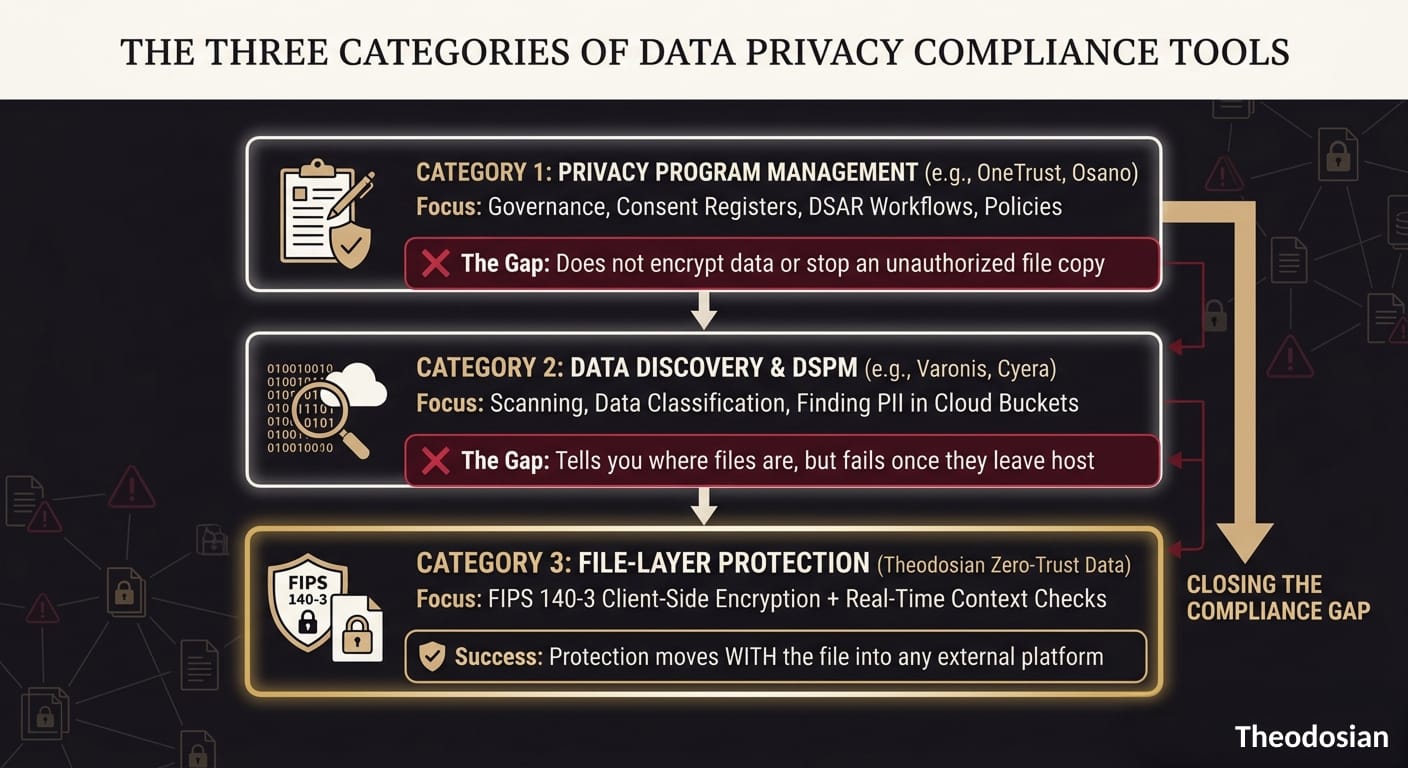
Category 1: Privacy Program Management
These tools manage the governance layer — consent, data subject requests, processing records, vendor assessments, privacy notices. OneTrust, TrustArc, Osano, and similar platforms live here. They're essential for running a compliant privacy program. They do not encrypt data or control file access.
Category 2: Data Discovery and Classification
These tools find where sensitive data lives across your environment — cloud storage, databases, endpoints. Varonis, Cyera, and Microsoft Purview's scanning capabilities fall here. They tell you that a folder in SharePoint contains 4,000 files with PII. They don't protect those files when someone downloads and emails them.
Category 3: Data Protection at the File Layer
These tools encrypt files and control access to them regardless of where the files travel. This is the layer that directly satisfies the technical security requirements in GDPR, HIPAA, and CCPA — because the protection stays with the data when it crosses platform boundaries.
Most mid-sized organizations have invested in Category 1 and sometimes Category 2. Category 3 is the gap most regulators and auditors will eventually find.
📋 Is Your Mid-Sized Organization Missing a Core Security Control?
Most privacy software manages the administrative paperwork but fails to defend files once they are downloaded or shared. Use our step-by-step framework to verify your technical posture.
How Do the Leading Data Privacy Compliance Tools Compare?
| Tool | Category | What It Protects | Compliance Gap |
|---|---|---|---|
| OneTrust | Privacy program management | Consent records, DSAR workflows, processing records | Data itself — no encryption or access control |
| Varonis | Data discovery / DSPM | Maps sensitive data locations, detects anomalies | Files after they leave the monitored platform |
| Microsoft Purview | Classification + sensitivity labels | Files within M365 on managed devices | Files outside M365, downloaded externally, personal devices |
| Kiteworks | Secure file transfer | Files during managed transfer workflows | Files after download from the Kiteworks environment |
| Theodosian | File-layer encryption + access control | Files in any environment — SharePoint, Google Drive, Dropbox, Box, endpoints, external sharing | Copy/paste/print prevention (IRM capability — on the roadmap) |
🛡️ Close the Compliance Gap Where the Data Actually Lives
Your privacy platform knows where files reside, but it can't protect them when an employee leaves or a contractor is offboarded. It's time to apply policy logic directly to the file layer with Theodosian.
FAQs: Data Privacy Tools
What is the difference between privacy compliance software and data protection tools?
Privacy compliance software manages the governance layer — consent records, data subject access requests, processing registers, vendor assessments, and privacy notices. These tools help organizations demonstrate they're running a compliant privacy program. Data protection tools (file encryption, access controls, audit logging) enforce the technical safeguards that privacy regulations require for the data itself. Most organizations need both. The governance layer defines your obligations; the technical layer enforces them on the actual data. The common gap at mid-market is strong governance tooling with weak or absent technical controls at the file layer — and regulators are increasingly checking both.
Does encrypting files satisfy GDPR technical safeguard requirements?
File encryption addresses one of the core technical measures GDPR Article 32 specifically names: "the pseudonymisation and encryption of personal data." Encryption alone doesn't satisfy the full scope of Article 32, which also covers organizational measures, system resilience, and breach detection. But encryption is the control that most directly determines regulatory exposure in a breach: GDPR's breach notification obligation applies when unauthorized parties can read the data. If files are encrypted with organization-controlled keys and the keys weren't compromised, the incident may not trigger notification obligations. This is the practical compliance value of file-layer encryption — it turns a notifiable breach into an administrative event.
What data privacy compliance requirements apply to mid-sized companies?
The applicable requirements depend on the data you process and where your customers are located — not your company size. GDPR applies if you process EU or UK resident data, regardless of organization size. HIPAA applies if you're a covered entity or business associate. CCPA/CPRA applies if you meet California's revenue or data processing volume thresholds — many mid-sized companies qualify. CMMC applies to any company in the US defense industrial base handling controlled unclassified information. The resources available change at mid-market scale, but the technical requirements don't. Mid-sized organizations need tools that provide enterprise-grade file-level controls without an enterprise-scale implementation program.