
"Data-centric security" has become one of the most overloaded terms in enterprise security. Vendors who build data discovery tools call themselves data-centric. Vendors who build classification engines call themselves data-centric. Vendors who build DLP tools call themselves data-centric.
The term has a specific meaning. Data-centric security means the protection mechanism travels with the data — not the container, not the platform, not the network perimeter. A truly data-centric architecture protects a file when it's in SharePoint, when it's downloaded to a contractor's laptop, when it's emailed to a sub-tier supplier, and when it lands in that supplier's Dropbox. The protection doesn't depend on where the file is. It's embedded in the file itself.
Most platforms that market themselves as data-centric protect their own environment. That's not data-centric security. That's container security with better marketing.
This guide maps the actual competitive landscape — what each platform does, where it stops, and how to evaluate whether a platform's "data-centric" claim matches what CMMC, ITAR, and HIPAA actually require.
What Does "Data-Centric Security" Mean?
The definition comes from the architecture, not the marketing. A data-centric security platform has three non-negotiable characteristics:
Protection that travels with the data: Encryption and access controls are embedded at the file or object level, not at the platform or storage level. A file exported from the platform carries the same protection with it. A file that moves from SharePoint to a contractor's Google Drive to a local endpoint remains protected at every point in that journey.
Access decisions made at the data layer: Authorization is evaluated at the point of the file access event — not at the point of login, not at the point of application access, not at the network perimeter. The access decision happens when a specific identity tries to open a specific file, with full evaluation of current context (device, location, network, behavioral signals).
Audit trail that follows the data, not the platform: Every access event generates a log record tied to the file, regardless of which platform the file is on. The audit trail is continuous and cross-environment — a file accessed in SharePoint generates the same log structure as the same file accessed on a contractor's NAS share.
By this definition, most platforms in the "data-centric security" category are providing some, but not all, of these characteristics. The buyer's job is to determine which gaps exist and whether those gaps create compliance exposure.
🔒 Move Beyond Container-Bound Security
If your CUI protection stops at SharePoint’s edge, your compliance program has a blind spot. Test how persistent, file-layer encryption maintains control even when data travels onto contractor endpoints or unmanaged clouds.
What's the Difference Between Data-Centric Security and Data Discovery / DSPM?
Data Security Posture Management (DSPM) tools — Varonis, Cyera, Rubrik Security Cloud — discover where sensitive data lives, assess its exposure, and alert on anomalies. They're valuable, but they're not data-centric security.
DSPM tells you: "You have 4,000 files containing PII in a SharePoint folder that 47 people have access to, and 12 of them haven't opened the folder in six months."
Data-centric security does something different: it ensures that when any of those 47 people opens one of those files, the access is authorized at the moment of opening, the file is encrypted with organization-controlled keys, and the access event is logged with full context — regardless of which device they're using or whether they're inside the corporate network.
Discovery tells you what's exposed. Protection prevents exposure from becoming a breach.
The gap matters for compliance because CMMC's AC domain, ITAR's encryption requirements, and HIPAA's Technical Safeguards all require demonstrated technical controls over data access, not just awareness of where data exists.
How Do the Leading Data-Centric Security Platforms Compare in 2026?
| Platform | Protection Layer | After-Export Protection | Audit Trail Scope | Deployment Complexity | CMMC/ITAR Ready |
|---|---|---|---|---|---|
| NextLabs | Application + data policy engine | ✅ Content-aware policy | Application-level + file | Months — requires policy engineering | ✅ (government focused) |
| Varonis | DSPM — discovery + behavioral analytics | ❌ Detection only, no file-layer enforcement | Platform-level detection | Weeks–months | Partial (discovery + alerting) |
| Seclore | File layer (IRM + copy/print prevention) | ✅ Including content extraction | Per-file, per-access | Months | ✅ |
| Theodosian | File layer (FIPS 140-3 AES-256, per file) | ✅ Across all platforms + endpoints | Per-file, cross-platform | Days | ✅ Direct mapping |
NextLabs operates at the intersection of data policy enforcement and enterprise rights management. Its policy engine can evaluate attributes across complex enterprise environments — a good fit for large defense primes with sophisticated policy management requirements. The platform requires significant implementation work and is primarily on-premise focused, which limits its fit for organizations running cloud-first environments.
Varonis is one of the best DSPM platforms available. It finds sensitive data, maps exposure, detects behavioral anomalies, and generates the kind of risk intelligence that security teams genuinely use. The clear boundary: Varonis is a detection and visibility platform. It doesn't encrypt files or enforce access at the file layer. For compliance frameworks that require technical controls (not just detection), Varonis satisfies part of the requirement — the discovery and alerting part — but not the enforcement part.
Seclore provides file-layer IRM with copy/paste/print prevention — a capability none of the other platforms in this table (including Theodosian) currently have. For organizations with hard requirements around content extraction prevention — specific classified environments, legal hold workflows, DRM-type use cases — Seclore addresses a real need. The trade-offs are significant: pricing typically starts at $27,000/year for smaller deployments and scales up, implementation takes months, and user friction from copy restrictions consistently generates workarounds in practice.
What Should a Data-Centric Security Platform Do for Your Compliance Program?
Three compliance requirements separate true data-centric platforms from discovery-and-label tools:
CMMC SC.L2-3.13.11 — FIPS-validated encryption for CUI: The encryption must be FIPS 140-2/3 validated and must protect CUI wherever it exists — not just within a specific cloud tenant or platform. A platform that encrypts data within its own environment satisfies this requirement inside that environment. When CUI leaves for a subcontractor's system, the FIPS encryption requirement doesn't follow it unless the platform encrypts at the file layer.
CMMC SC.L2-3.13.10 — Organization-controlled cryptographic keys: Your organization must control the cryptographic keys used to protect CUI. If the platform vendor holds the keys, this requirement is not satisfied. If keys are generated and managed within the vendor's infrastructure (even as BYOK), the "organizational control" requirement is weakened. Zero-knowledge architecture — where the vendor never processes key material — satisfies this by design.
CMMC AU.L2-3.3.1/3.3.2 — Per-access audit logging: Every access to CUI must generate a log record capturing user identity, event type, date, time, success/failure, and event source. "Every access" means every access — not every access within a specific platform. If your audit trail has a gap for files that were downloaded or shared externally, that gap is what a C3PAO will find.
How Does Theodosian Deliver Data-Centric Security at the File Layer?
Theodosian's architecture implements all three characteristics of genuine data-centric security:
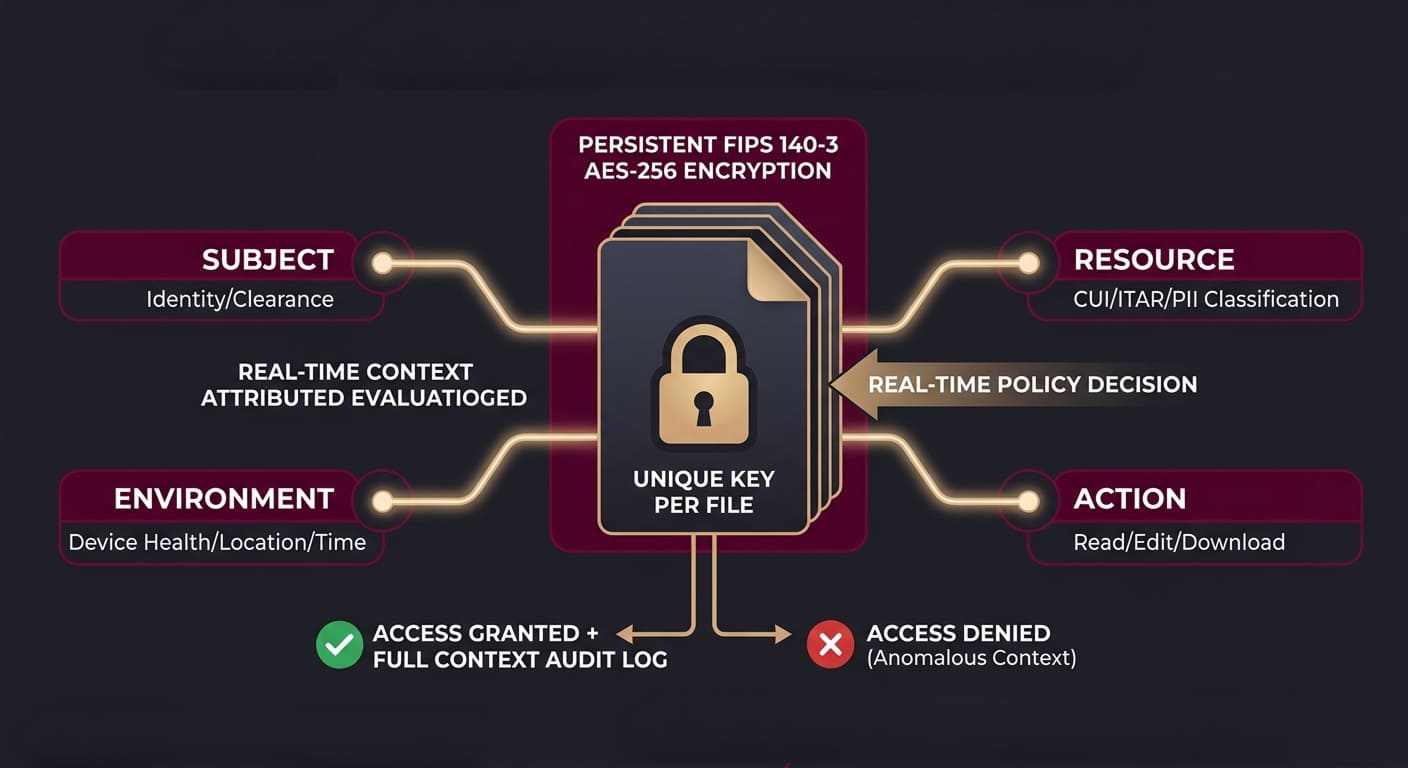
Protection that travels with the data: FIPS 140-3 validated AES-256 encryption is applied per file, with a unique cryptographic key per file. The encryption follows the file into SharePoint, Google Drive, Dropbox, Box, Windows file servers, NAS shares, and local endpoints. A file downloaded to a contractor's laptop carries the same encryption it had in SharePoint.
Access decisions at the data layer: Context-aware access controls evaluate every file open request against real-time attributes — authenticated identity, device compliance status, geographic location, network type, time of access, and behavioral baseline. The evaluation happens at the file layer, not the session layer. A file encrypted by Theodosian requires a live policy evaluation to decrypt, regardless of which platform it's on.
Audit trail that follows the data: Every access event generates a structured log record: user identity, file name and sensitivity classification, device type and compliance status, timestamp, location, network type, and policy outcome. That record exists for access events across all integrated platforms — not just within Theodosian's own environment.
Patent-pending zero-knowledge key architecture means your organization holds the decryption keys. Theodosian cannot access them. Deployment in days with no data migration. Two-week proof of concept. Integrations with SharePoint/OneDrive, Google Drive/Workspace, Dropbox, Box, Windows file servers, and NAS shares. Identity providers: Active Directory, Okta, Google Workspace, SAML/OIDC.
🚀 Close the Gap Between Discovery and Enforcement
Discovery tools tell you what's exposed—Theodosian helps prevent exposure from becoming a breach. Schedule a demo to evaluate our zero-knowledge architecture in your own storage environment.
Related Reading:
- What Is a Data-Centric Security Platform, and Why Are Defense Contractors Starting to Pay Attention?
- DSPM vs. File Encryption: Why Data Discovery Isn't Data Protection
- What DSPM Misses, and How to Close the Gap
- Enterprise Data Protection: The Layer Your Security Stack Is Missing
- What Is Data Classification, and Why Is It Not Enough to Protect Sensitive Data
FAQs: Evaluating Data-Centric Security Platforms
What is data-centric security and how does it differ from perimeter security?
Perimeter security protects the boundary around your environment — firewalls, VPNs, network access controls, and endpoint detection tools that assume threats come from outside and trusted users are inside. Data-centric security protects the data itself, regardless of where it is. The protection mechanism — encryption and access controls — is embedded at the file or data level and travels with the data when it moves. The practical difference: a perimeter breach (credential theft, insider threat, misconfigured cloud storage) immediately exposes all data inside the perimeter. A data-centric architecture means each file requires independent authorization to decrypt, regardless of who has network access. Perimeter security protects the walls. Data-centric security protects what's inside — even when the walls fail.
How do I evaluate whether a data-centric security platform satisfies CMMC Level 2?
Start with three questions. First: does the platform apply FIPS 140-2/3 validated encryption at the file layer, and does that encryption follow files when they leave the platform's native environment? Second: who controls the cryptographic keys — your organization, or the vendor? CMMC SC.L2-3.13.10 requires organization-controlled keys. Third: does the platform generate per-access audit logs capturing user identity, device, location, and timestamp for every file access event, including events that occur outside the vendor's platform? Platforms that satisfy all three are genuinely data-centric for compliance purposes. Platforms that satisfy one or two have gaps that a C3PAO will identify.
Can a data-centric security platform replace DLP?
They address different problems. DLP monitors data in motion — detecting when sensitive data is being sent to unauthorized destinations and alerting or blocking based on policy. Data-centric security protects data at rest and in use — ensuring authorized users can access files while preventing unauthorized access, and maintaining an audit trail of every access event. DLP detects when a file is being sent somewhere it shouldn't go. Data-centric security ensures that even if the file reaches an unauthorized party, they can't open it. For regulated data under CMMC, ITAR, and HIPAA, the technical control requirement — demonstrated, auditable protection at the data layer — is what data-centric security provides. DLP is a monitoring and detection tool that works alongside it.