
It's 2:14 AM. Your Varonis console lights up. Anomalous file access: 340 files in 12 minutes, all tagged as CUI. The user account is valid. The access pattern is wrong — bulk reads, off-hours, unfamiliar endpoint.
Your team is on it within six minutes. Good response time, but the files were already read.
This is not a knock on Varonis. Their detection worked. The alert was accurate, the anomaly was real, and the platform flagged exactly what it was built to flag. The problem is architectural: by the time detection fires, the data has moved. In a world where credential abuse occurs in 39% of all breaches, and the human element drives 62% of incidents, the attacker doesn't look like an attacker. They look like a user. And valid users can read plaintext files.
This post is about what that gap costs, and how organizations are starting to think about closing it.
What Does Varonis Do?
Before comparing tools, it's worth being precise about what Varonis actually is, because it is often mischaracterized as "just" a monitoring tool. That undersells it significantly.
Varonis is a data security and analytics platform. With $561.8M in FY2024 revenue and a publicly traded position, it has scaled by solving a real problem: organizations don't know where their sensitive data lives, who can access it, or whether that access is appropriate. Varonis addresses all three with genuine depth.
Its core capabilities include automated data discovery and classification across structured and unstructured data, access governance that maps which users can reach which files and surfaces over-permissioned paths, and behavioral threat detection that builds baselines for normal access and flags deviations. It achieved FedRAMP Authorization in May 2025, a meaningful compliance credential reflecting rigorous review against federal security standards.
For any security team that has fought the sprawl problem — sensitive files scattered across SharePoint, file shares, email attachments, and cloud storage with no clear ownership or access audit trail — Varonis is a serious, well-built answer. Its analytics are best-in-class. The CISO who deploys Varonis gains visibility they almost certainly didn't have before.
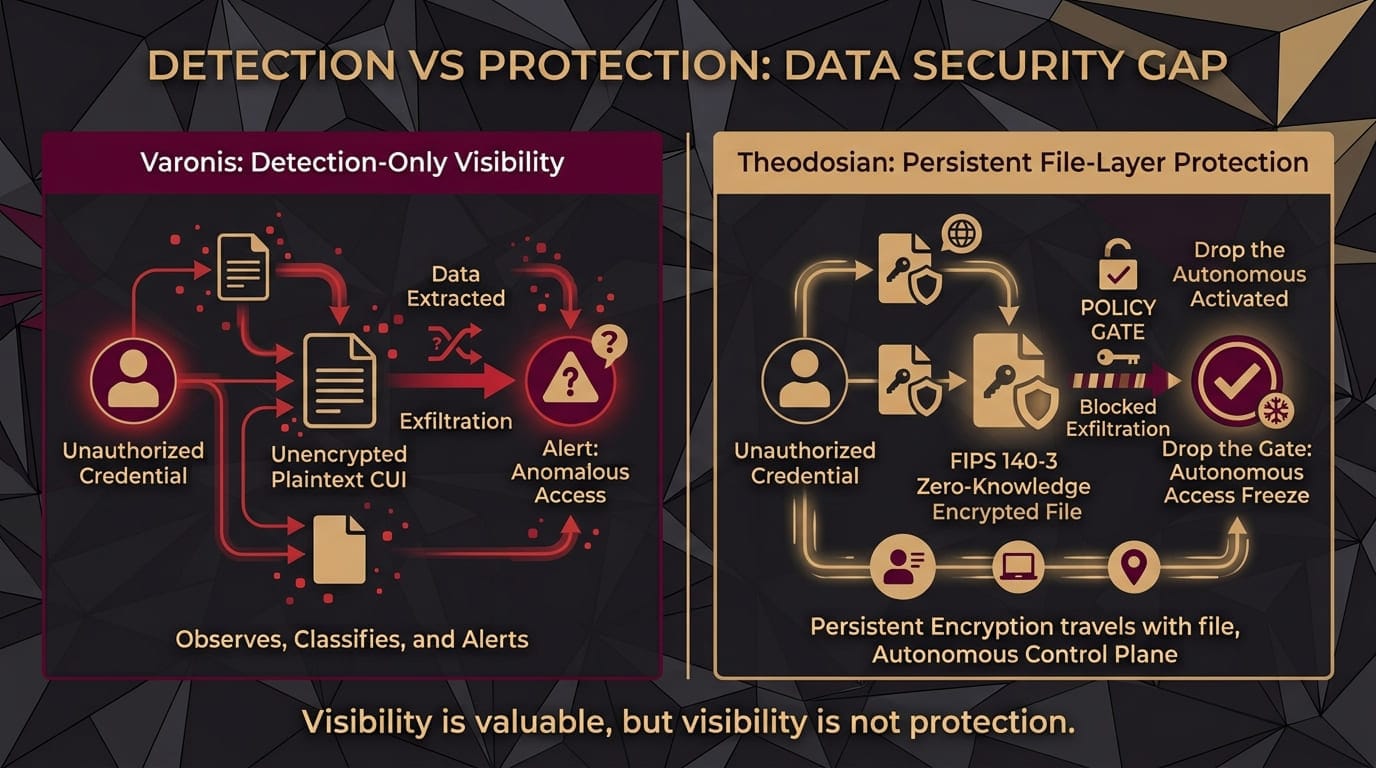
Visibility is valuable, but visibility is not protection.
🛡️ Stop Credentialed Access turning into Plaintext Data Exfiltration
Varonis alerts you after an authorized credential reads sensitive files. See how zero-knowledge per-file encryption blocks plaintext access at the control plane before exfiltration happens.
Where Does Varonis' Protection End?
Here is the architectural fact that should drive every purchasing conversation: Varonis is a detection and discovery layer. It observes, classifies, and alerts. The files it catalogs remain plaintext.
That matters for one specific reason: threat actors with valid credentials.
When a Varonis alert fires on anomalous access, two things are simultaneously true. The platform has done its job — it identified suspicious behavior and surfaced it for investigation. And the files are already readable by whoever triggered the alert. Detection happens after read. There is no mechanism in the Varonis architecture that prevents a credentialed user from opening a file, copying it, or exfiltrating it to an authorized personal device before the alert is investigated and acted on.
This is the blast radius problem. Varonis maps your exposure with precision. It tells you exactly how many files are at risk, who could reach them, and what anomalous access looks like. What it cannot do is shrink the blast radius when a breach happens, because the data itself has no protection layer. The file is the same whether the person opening it is authorized or not.
For a deeper look at why data discovery and data protection are distinct problems that require distinct solutions, DSPM vs file encryption covers the architectural difference in detail.
This gap is not a flaw in Varonis's design. It is a scope decision. Varonis was built to solve the visibility problem. For organizations that have solved visibility and still face plaintext exposure, a different layer is required.
How Does Theodosian vs Varonis Compare on Key Capabilities?
The table below maps both platforms against the capabilities most relevant to defense contractors and regulated enterprises managing CUI, ITAR-controlled data, or sensitive intellectual property.
| Capability | Varonis | Theodosian |
|---|---|---|
| Data discovery & classification | ✅ Best-in-class | ❌ Not in scope |
| Behavioural threat detection | ✅ Core strength | Partial (anomaly detection at file access) |
| Per-file encryption | ❌ | ✅ FIPS 140-3 validated, unique key per file |
| Zero-knowledge key management | ❌ | ✅ Patent-pending — vendor never processes keys |
| Protection after download/exfiltration | ❌ | ✅ File-layer encryption travels with file |
| Autonomous access freeze | Alert only | ✅ Drop the Gate — automatic freeze + step-up MFA |
| AI identity brokering | ❌ | ✅ Governed AI access per file |
| Context-aware access controls | ❌ | ✅ Identity, device, geo, network, time, behaviour |
| FedRAMP | ✅ ATO May 2025 | Runs on FedRAMP Moderate infrastructure |
| Deploy time | Weeks | Days |
| Protection when files leave environment | ❌ | ✅ |
The table makes the division clear: Varonis owns the discovery and detection layer; Theodosian owns the protection layer. These are not overlapping products competing for the same budget line. They address adjacent problems on the same surface.
When Do You Need Detection, and When Do You Need Protection?
The organizations that outlast industry inflection points are the ones that assume the worst-case scenario is already in motion and build accordingly. That argument applies directly to how security teams should think about their data security architecture right now.
The worst-case scenario for a defense contractor in 2026 is not a failed perimeter breach. The perimeter has already failed, repeatedly, across the industry. The worst case is an attacker who is already inside the environment, using valid credentials, reading files that Varonis has already classified as sensitive. The blast radius is determined not by whether the attack is detected, but by what the attacker can do before the detection is acted on.
Consider the cost context: the average annual cost of insider risk reaches $19.5M per organization, spiking even higher when incidents take over 90 days to contain.
That figure covers response, investigation, legal exposure, and contract risk, not just immediate technical damage. Detection without protection does not change that number. It tells you the incident happened, faster. What changes the number is limiting what the attacker can read even after access is gained.
Understanding what an insider threat actually is and why detection-only responses to insider risk are architecturally insufficient is worth doing before any procurement conversation about data security tools.
The answer to "detection or protection?" is not "one or the other." It is: in what order, given your current exposure?
If you have no visibility into where your sensitive data lives, start with Varonis. If you have visibility and your files are still plaintext, the protection layer represents the largest gap in your actual risk posture. For organizations already operating under CMMC Level 2 or ITAR requirements, auditors are increasingly asking not just whether sensitive data is identified, but whether it is encrypted at rest and in transit, and whether that encryption follows the file when it leaves the environment.
How Do Varonis and Theodosian Work Together?
The strongest security posture does not pick between visibility and protection. It uses both, and each tool makes the other more effective.
Varonis discovers and classifies your sensitive data. That classification feeds directly into Theodosian's policy layer: the files Varonis identifies as CUI, ITAR-controlled, or highly sensitive become the files Theodosian protects with per-file FIPS 140-3 validated AES-256 encryption, with a unique key assigned to each file. Varonis's access governance output informs which users and roles receive access under Theodosian's context-aware controls: identity, device posture, geolocation, network, time of access, and behavioral signal.
When Varonis detects an anomaly, Theodosian's Drop the Gate capability moves from alert to autonomous access freeze, requiring step-up MFA before any further access is permitted. Detection triggers protection. The two tools operating in tandem create a response architecture that neither detection-only nor encryption-only deployments can achieve independently.
This is what a data-centric security platform looks like in practice: not a single tool that handles everything, but a layered architecture where each component handles the problem it was designed to solve.
Theodosian's patent-pending zero-knowledge key management architecture means the vendor never processes your encryption keys. That holds as files move between environments. When a file classified by Varonis as ITAR-controlled leaves your network, whether attached to an email, downloaded to an endpoint, or shared with a subcontractor, the encryption travels with it. Varonis can alert on unauthorized access patterns. Theodosian ensures that even if access occurs, the content is not readable without a valid key under current access policy.
For a full explanation of how zero-knowledge encryption works and why it matters for enterprise file security, the zero-knowledge encryption explainer is worth reading before structuring any vendor evaluation.
Which Organizations Should Prioritize File-Layer Encryption?
Not every organization needs to solve the same problem in the same order. The following scenarios describe where prioritizing Theodosian's protection layer has the highest marginal impact on real risk.
Defense contractors operating under CMMC Level 2 or preparing for Level 3: CMMC's CUI protection requirements are specific about encryption at rest and in transit. Knowing where your CUI is does not satisfy those requirements. Encrypting it does. If your CMMC readiness assessment has already identified and classified your CUI, protecting it is the next step, and audit-ready access logs that demonstrate per-file, per-user access under policy will matter when your C3PAO walks in.
Organizations managing ITAR-controlled technical data: ITAR's data control obligations follow the data, not the network. A file exported to a foreign national or unauthorized third party creates liability regardless of whether an alert fired. Per-file encryption that enforces access policy after the file leaves the environment addresses the ITAR control obligation in a way that monitoring cannot.
Financial services managing sensitive financial records or PII: GLBA, SEC, and NYDFS cybersecurity regulations demand strict controls around customer data access. File-layer encryption ensures financial records, customer PII, and sensitive trading data remain protected against credential misuse and insider access.
Healthcare organizations subject to HIPAA compliance: Electronic Protected Health Information (ePHI) requires rigorous safeguards. Per-file encryption secures patient records across endpoints and cloud shares, ensuring regulatory compliance even if network or account credentials are compromised.
Any organization with a documented credential theft exposure: If your threat modeling acknowledges that an attacker in possession of valid credentials is a realistic scenario — and it should, given the 93% figure — then your data security architecture needs to account for what happens when detection is too slow. The answer is not faster detection alone. It is making the data inaccessible without authorization even when credentials are valid.
For a detailed look at how per-file encryption compares to disk encryption and DLP as a protection model, per-file encryption vs disk encryption vs DLP covers the architectural distinctions in full.
Theodosian deploys in days, with a two-week proof of concept available for qualified defense contractors.
🔒 Add File-Layer Security to Your Existing Visibility Architecture
Protect CUI, ITAR data, financial records, and ePHI with FIPS 140-3 per-file encryption without replacing your existing discovery tools.
FAQs: Varonis vs. Theodosian (Detection vs. Protection)
Is Theodosian a replacement for Varonis?
No. Varonis and Theodosian solve adjacent problems. Varonis is a data discovery, classification, and behavioral detection platform. Theodosian is a file-layer encryption and access control platform. Varonis tells you where your sensitive data is and flags anomalous access. Theodosian protects the files themselves so that unauthorized access does not result in readable data exposure. Organizations running both get visibility and protection — the strongest posture for managing insider threats and credential-based attacks.
Does Theodosian replace the need for DSPM or data classification tools?
Data classification is not a Theodosian capability. Theodosian enforces encryption and access policy on files, but identifying which files require protection is a separate function. Tools like Varonis, or a broader DSPM solution, identify and classify sensitive data. That output feeds Theodosian's policy layer. If you have no classification in place, starting with discovery is the right call. If classification is complete and files are still plaintext, Theodosian is the next step in your architecture.
Is Theodosian FedRAMP Authorized?
Theodosian runs on FedRAMP Moderate infrastructure. That is distinct from holding a FedRAMP Authorization to Operate in its own right. Varonis achieved FedRAMP ATO in May 2025, which is a meaningful compliance credential for federal procurement. Organizations evaluating both tools for federal use cases should factor the current authorization status into their procurement timeline and risk posture.
How does Theodosian's zero-knowledge architecture work?
Theodosian's patent-pending zero-knowledge key management means encryption keys are generated and stored in a way that Theodosian, as a vendor, never has access to them. This eliminates vendor-side key compromise as a risk vector and supports compliance positions that require demonstrable data sovereignty. The zero-knowledge encryption explainer covers the full architecture.
What does "Drop the Gate" mean?
Drop the Gate is Theodosian's autonomous response capability. When access behavior triggers a defined policy threshold — bulk file access, off-hours reads from an unrecognized device, access conflicting with established policy — Drop the Gate freezes access automatically and requires step-up MFA before any further reads are permitted. It moves the response from "alert and investigate" to "alert, freeze, and verify," changing the exposure window from minutes to seconds.