
Here's a scenario: a 22-person aerospace manufacturer in Ohio spent nine months preparing for CMMC Level 2. They built their System Security Plan, remediated non-deferrable controls, scored 91 on their self-assessment, and selected their C3PAO based on one criterion: lowest quote.
Three weeks into the assessment, the C3PAO flagged four configuration items that the company's MSP had certified as compliant. The company had no documentation trail showing the MSP's rationale. The assessment stalled for six weeks while evidence was gathered and controls were re-documented.
They eventually certified. Six weeks later than planned. At $28,000 more than the original quote.
The C3PAO isn't the last step in your CMMC program. It's the organization that decides whether everything you built meets the bar, and how efficiently that decision gets made. Choosing wrong doesn't just cost money. It costs time you may not have with the November 2026 deadline approaching.
What Is a C3PAO, and Why Does Your Choice of Assessor Matter?
A C3PAO — Certified Third-Party Assessment Organization — is a company authorized by the CMMC Accreditation Body (CMMC-AB) to conduct official CMMC Level 2 assessments. They're the only organizations that can issue a CMMC Level 2 certificate. An RPO (Registered Provider Organization) can help you prepare. An MSP can build your controls. Neither can certify you.
There are currently over 60 authorized C3PAOs listed on the CMMC marketplace. They vary in size, experience, specialization, pricing, and booking wait times. Some specialize in small contractors. Others work primarily with primes and large enterprises. Some have deep experience in your vertical. Others don't.
The outcome of your CMMC assessment depends on three things: what you built, whether it actually meets the standard, and whether the C3PAO has the experience to evaluate it fairly and efficiently. You control the first two. The third depends on who you hire.
A C3PAO’s Job Isn’t to Help You Pass, It’s to Grade You.
Before you lock into an assessment contract, you need to be absolutely certain your evidence package can withstand a strict audit. The quickest way to fail is to realize your encryption controls don't travel with your data after an assessor digs into your file flows.
How Do You Verify That a C3PAO Is Legitimately Authorized?
Start with the CMMC Marketplace. Every authorized C3PAO is listed there with current certification status. A company claiming C3PAO status that isn't on the marketplace cannot legally issue a CMMC certificate. Full stop.
Check the listing carefully:
Active status: The organization's C3PAO certification must be current, not expired or suspended.
Certified assessors: Individual assessors conducting your assessment must be Certified CMMC Assessors (CCAs). Verify that the specific people assigned to your engagement hold current CCA certifications. The names are searchable on the CMMC-AB ecosystem.
No conflict of interest: A C3PAO that also provides consulting, implementation, or remediation services to the same organization creates a conflict of interest that CMMC-AB prohibits. Some organizations have separate C3PAO and consulting arms — confirm the separation is real and documented, not organizational theory.
This verification takes 20 minutes. Skip it, and you're trusting a credential claim you never confirmed.
What Experience Should a C3PAO Have with Small Defense Contractors?
The 110 NIST SP 800-171 practices that constitute CMMC Level 2 look the same on paper regardless of company size. The assessment looks very different in practice.
A 15-person IT subcontractor's CMMC environment looks nothing like a 500-person prime's.
Small contractors typically run:
- Smaller CUI scopes — often just a handful of engineers actually handling CUI
- Shared IT infrastructure with non-CUI systems
- Thinner documentation culture — policies may exist, but evidence trails may be sparse
- One or two people owning the entire compliance program, sometimes without a formal security background
A C3PAO that primarily assesses large primes may expect documentation patterns or system configurations that don't exist at smaller companies. They may flag gaps that aren't actually non-compliant, just unfamiliar.
Ask directly: how many assessments have they completed for companies in your size range and sector? What does their team's background look like for small business environments? The answer tells you whether their reference point matches your context.
How Much Does a C3PAO Assessment Cost, and What Should the Price Include?
For small defense contractors — 20 to 100 people, limited CUI scope — C3PAO assessment fees typically run $25,000 to $75,000 for a Level 2 assessment. Larger organizations or complex environments push well above $100,000.
That range is wide because the fee varies by:
- Scope size: how many systems, people, and locations are in your CUI environment
- Assessment format: fully remote, versus hybrid, versus on-site
- Assessor time: how complex your environment is to document and verify
- Travel costs: if on-site is required
A quote should include a clear scope of work. You need to know exactly what's covered:
- How many days of assessor time?
- Does it include a review of your SSP before assessment begins?
- What's the remediation process if minor findings emerge mid-assessment?
- Are Notices of Findings and Observations and eligible POA&M items reviewed as part of the fee?
The cheapest quote isn't always the cheapest assessment. A C3PAO that under-prices and then bills for scope expansions or unexpected remediation cycles will cost more than a higher upfront quote with a defined scope. The Ohio contractor at the top of this post found that out.
How Far in Advance Do You Need to Book a C3PAO Assessment?
Further than most contractors expect.
The CMMC marketplace has had consistent capacity constraints. As of mid-2026, with the November Level 2 deadline approaching, booking windows at quality C3PAOs have extended to four to six months in some cases. If you want to assess in September or October 2026, you're already behind on the booking timeline.
The practical implication: readiness preparation and C3PAO selection need to run in parallel, not sequentially. Waiting until you're confident you're ready before contacting a C3PAO means you may not get an assessment slot before the deadline.
Engage C3PAOs now, even if you're still remediating gaps. A conversation about your environment and timeline doesn't commit you to a date, but it gets you in the queue. Most C3PAOs will work with scheduling flexibility once you're engaged.
What Is a CMMC Pre-Assessment, and Do You Need One?
A pre-assessment is a practice run conducted by an RPO or your own internal team before the official C3PAO assessment begins. It isn't a formal CMMC requirement, but it's one of the most cost-effective investments a small contractor can make.
The case for it: C3PAOs are paid to assess, not coach. If they find a gap in your SSP or a control that isn't implemented as documented, that becomes a Notice of Findings and Observations — and depending on the finding, may extend your assessment significantly. An RPO-conducted pre-assessment catches the same gaps in a lower-stakes environment where remediation doesn't cost you the assessment itself.
Some C3PAOs also offer their own readiness review before the formal assessment starts. This differs from an independent pre-assessment in that the organization conducting both the review and the subsequent assessment is the same, which raises objectivity questions worth considering.
Decision framework: if you've done a thorough gap assessment and self-scored against all 110 practices with some external validation, an independent pre-assessment is less critical. If your gap assessment was internal-only or your self-score revealed multiple marginal controls, it's likely worth the investment.
What Are the Red Flags When Evaluating a C3PAO?
They're not on the marketplace. The CMMC-AB marketplace is the authoritative list. Not on it means not authorized.
They promise a pass. No C3PAO can guarantee certification before reviewing your environment. If an assessor says your certification is assured, that's either dishonest or incompetent, disqualifying either way.
Assessors aren't CCA-certified. Individual credentials are verifiable. If the C3PAO can't give you assessor names before you sign, ask why.
They also sell you the remediation. A C3PAO that offers to assess you and then sell tools or MSP services to fix what they find has a financial conflict that CMMC-AB rules prohibit. Verify the separation between their assessment and consulting arms is real.
Vague scope of work. A professional C3PAO provides a detailed statement of work before you sign — assessor days, deliverables, scope boundaries, and remediation process. Two paragraphs without specifics is a blank check.
No experience with your sector. CMMC Level 2 requires specific knowledge of the defense industrial base, CUI categories relevant to your contract, and DFARS requirements. A C3PAO without that sector fluency may be technically qualified but will assess less efficiently.
What Eight Questions Should You Ask a C3PAO Before Signing?
These questions surface everything you need to make an informed selection:
- How many CMMC Level 2 assessments have you completed for companies of our size and in our sector?
- Who specifically will conduct our assessment, and can you confirm their current CCA certifications?
- What does your scope of work include — how many assessor days, what deliverables, and what's explicitly excluded?
- What's your process if you find a minor gap during the assessment? How does remediation work within the assessment timeline?
- Do you also provide CMMC consulting, tools, or MSP services — and if so, how is that separation from your assessment practice enforced?
- What's your current booking window for a Level 2 assessment?
- What evidence format do you expect for documentation-heavy controls — specifically AU domain audit logs and SC domain encryption evidence?
- What does the path to Conditional CMMC certification look like if we have eligible POA&M items, and how does your process support that outcome?
That last question matters for small contractors in particular. If your SPRS score is 88 or above, and the remaining gaps are eligible for a POA&M, a Conditional CMMC certificate is achievable. A C3PAO that understands the POA&M process for small organizations gives you a cleaner path than one that treats every gap as a straight assessment failure.
Does Your Evidence Package Hold Up Before the C3PAO Walks In?
A C3PAO assesses what you can demonstrate, not what you've built. The two aren't always the same.
The most common source of assessment delays isn't missing controls. It's missing evidence. A control that's implemented but not documented is, from an assessment standpoint, a control that can't be verified. Your SSP must describe every control as it's actually implemented, with artifacts that confirm it: configuration screenshots, policy documents, acknowledgment records, access logs, and encryption documentation.
Two controls that small contractors consistently under-document:
SC.L2-3.13.11 (FIPS 140-3 validated encryption for CUI wherever it lives): You need more than a statement that encryption is in use. You need documentation of your encryption implementation, confirmation that cryptographic modules are FIPS 140-3 validated, and evidence that CUI files are encrypted wherever they exist — not just in your primary cloud environment. If a CUI file has ever been downloaded to a laptop, emailed to a prime, or shared outside your primary tenant, your evidence needs to account for that.
AU.L2-3.3.1 and AU.L2-3.3.2 (audit logging of CUI access events): Your C3PAO will ask for access logs covering your assessment period. Default cloud platform audit logs often capture login events — not per-file access events with the context assessors expect. Know what your logging actually captures before the assessor asks.
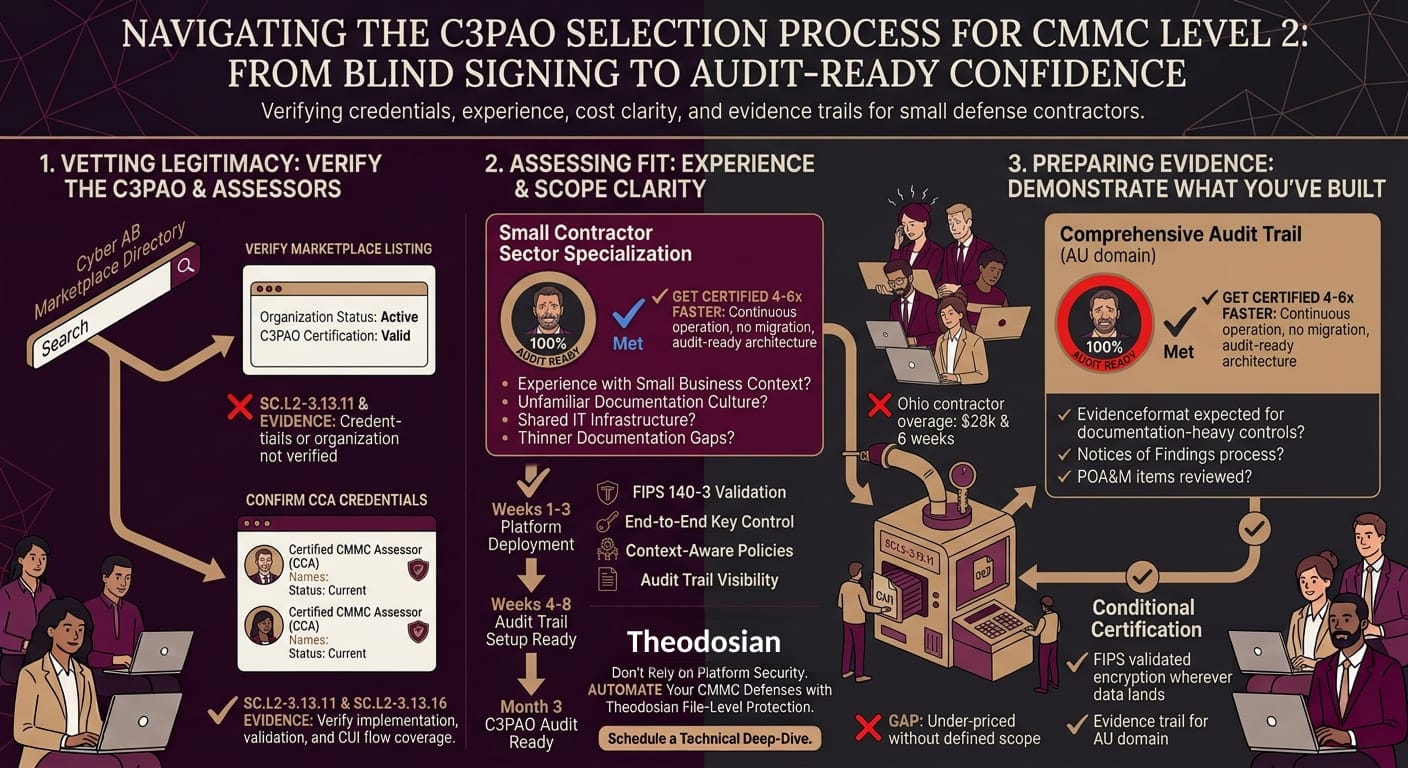
Theodosian addresses both gaps at the file level. Per-file FIPS 140-3 validated encryption with organization-controlled keys satisfies SC.L2-3.13.11 and SC.L2-3.13.16 regardless of where a CUI file has traveled — because the protection travels with the data. Every access event is logged automatically: authenticated user identity, device, location, IP, network type, and policy outcome. Those logs are exportable on demand for your assessment team. Control that travels with the data means your evidence trail doesn't have a gap where the file left your primary environment.
Don't Let a Missing Evidence Trail Stall Your Certification
When a C3PAO asks to see proof of your FIPS-validated encryption or file-access logs, pointing to a standard cloud folder isn't going to cut it. Discover how Theodosian automates your evidence collection at the file layer, giving your auditors exactly what they want to see on day one.
FAQs: Navigating Your C3PAO Assessment
Can we fail a CMMC assessment entirely over a single minor gap?
Not necessarily, thanks to the introduction of Conditional Certifications. If your initial assessment score is 88 or higher, and the remaining gaps are "eligible" items (meaning they aren't critical, non-deferrable controls like FIPS encryption or multi-factor authentication), your C3PAO can issue a Conditional Certification. This gives you a strict 180-day window to remediate those minor gaps via a Plan of Action and Milestones (POA&M) without failing the audit outright.
If our MSP says we are compliant, why do we need to double-check our evidence?
Because your MSP is an implementation partner, not a certified auditor. An MSP might configure an environment correctly, but if they haven't documented the specific architectural rationale or kept historical logs showing the controls in action, a C3PAO cannot verify it. Under CMMC, if an implementation isn't backed by an active, reviewable artifact or log, the control is marked as "Not Met."
What happens if our C3PAO finds a major gap mid-assessment?
If a major, non-deferrable control is missing or improperly implemented, the C3PAO will issue a Notice of Finding. Depending on your contract with the C3PAO, they may allow a brief "pause" for you to execute a rapid fix, or they may have to halt the assessment entirely, requiring you to reschedule and repay for a secondary evaluation once the remediation is complete. This is why a thorough pre-assessment is highly recommended.