
A security team runs their first DSPM scan. The results come back: 47,000 sensitive files scattered across cloud storage, SaaS apps, shared drives, and a few places nobody was expecting. Contracts, credentials, engineering specs, personal data — all classified, mapped, and sitting in a dashboard.
The CISO looks at the report and asks, "Great, now what?"
That is where most DSPM conversations stop. And it's exactly the right question to ask before building your data security program around discovery tools alone.
What Is DSPM and What Does It Actually Do?
Data Security Posture Management (DSPM) is a category of security tools designed to discover, classify, and map sensitive data across cloud environments. The core job is visibility: finding out where sensitive data lives, who has access to it, whether that access is appropriate, and where the exposure risks are hiding.
The leading platforms in this space — Wiz, Varonis, Cyera, Concentric AI, Sentra — do this well. They scan across AWS, Azure, Google Cloud, and SaaS applications. They classify files based on content, identifying PII, financial data, intellectual property, health records, and regulated information. They surface overexposed files, flag misconfigured permissions, and alert teams when sensitive data lands somewhere it should not be.
That is genuinely useful. Most organizations have no clear picture of where their sensitive data actually lives. DSPM gives them that picture. The question is what happens after the picture is taken.
What Are the Limitations of DSPM for Protecting Sensitive Files?
DSPM is a discovery and governance tool; it’s not a protection tool. The difference between the two matters more than most security vendors want to acknowledge.
When a DSPM platform finds a sensitive file in the wrong place, your response options are to alert the team, remediate the misconfiguration, and adjust permissions. What DSPM does not do is encrypt that file, attach access controls to it, or ensure it stays protected the next time it moves.
A few specific gaps worth understanding:
Discovery does not equal encryption: Finding a file that contains sensitive data and flagging it as high-risk does not change what happens if that file gets downloaded, emailed, or shared externally. The file itself remains unprotected.
Posture management is point-in-time: DSPM tells you what your data posture looks like at a given moment. Files move, people download them, sync them, share them with external parties. Every time a file leaves a managed environment, it exits the DSPM platform's visibility. There is nothing attached to the file to protect it in transit.
Remediation requires human action: DSPM surfaces the problem. Someone still has to fix it. In practice, that means opening tickets, investigating findings, and adjusting permissions — hoping nobody accessed the file in the meantime. It’s a reactive loop, not a preventive one.
None of this is a criticism of DSPM; it is a description of what the category was built to do. The problem comes when organizations treat discovery as the end of the data security program rather than the beginning.
Finding a Leaking File on a Dashboard Doesn't Stop it From Being Copied
DSPM tools excel at showing you where your data is exposed, but they leave the actual remediation up to a manual, slow-moving ticket queue. If you are handling regulated data under NIST SP 800-171 or CMMC, you can't rely on reactive cleanups. You need controls that prevent exposure before the file ever moves.
Where Does DSPM Stop and File-Level Security Begin?
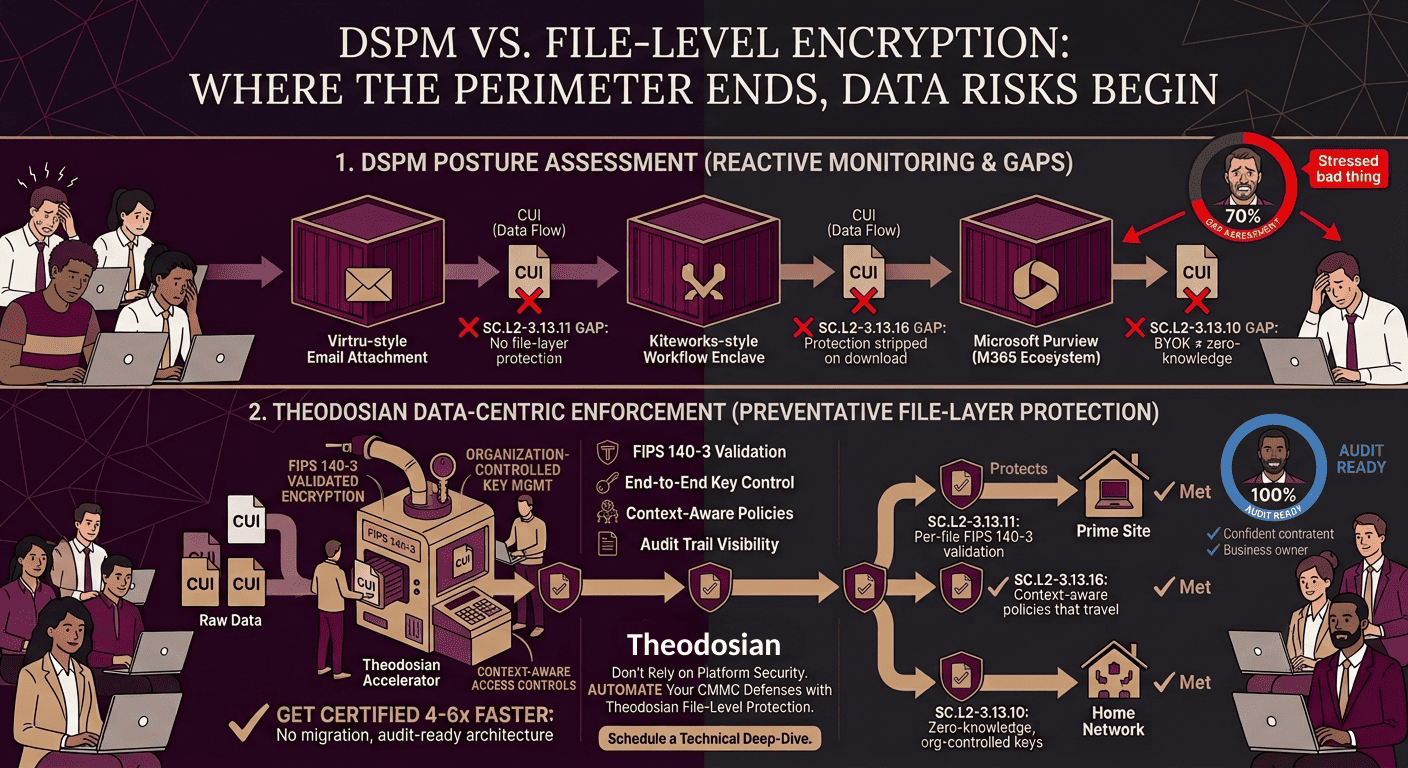
The dividing line is clean: DSPM protects the environment. File-level security protects the file.
DSPM can tell you that a sensitive file exists in a storage bucket with overly permissive access. File-level security ensures that even if someone downloads that file from the bucket, they still cannot open it without authorization, because the encryption and access controls are embedded in the file itself, not in the bucket's permission settings.
That architectural difference has a real practical consequence. When a file moves through email, a shared drive, a third-party portal, or onto an endpoint, DSPM's visibility ends at the environment boundary. File-level protection follows the file into every environment it enters.
For regulated data specifically, this matters a lot. NIST SP 800-171 SC.L2-3.13.11 requires FIPS-validated encryption for CUI wherever it lives, not just within your primary cloud tenant. DSPM can confirm your cloud environment is configured correctly. It cannot satisfy the "wherever it lives" requirement for files that have already moved beyond that environment.
Can DSPM and File-Level Encryption Work Together?
Yes. In fact, this pairing is the most effective architecture for organizations handling regulated or high-value data.
DSPM handles discovery and governance: finding sensitive data, classifying it, surfacing exposure risks, and maintaining visibility across cloud and SaaS environments. File-level encryption handles protection: ensuring that every sensitive file carries its own encryption and access controls regardless of where it ends up.
The two tools answer different questions. DSPM answers: where is my sensitive data, and is it exposed? File-level encryption answers: what happens to that data if it gets accessed or moved by the wrong person?
Used together, you get both visibility and protection. DSPM without file-level protection leaves the "now what" question unanswered. File-level protection without DSPM means you are securing files you know about while missing the ones you have not found yet.
What Does File-Level Protection Look Like?
A file-level security platform embeds encryption and access policy directly into each sensitive file before it leaves your environment. When someone requests access, the platform evaluates real-time conditions — who they are, what device they are on, where they are connecting from, and whether their behavior looks normal — then grants or denies access based on those conditions, not just whether they have the right credentials.
Theodosian uses this approach with a three-layer architecture: per-file FIPS 140-3 validated AES-256 encryption with a unique key per file, context-aware access controls evaluated in real time, and a comprehensive audit trail that captures every access event regardless of which environment the file is in.
The access controls go beyond identity. Device compliance status, location, network type, time of access, and behavioral anomalies all feed into the access decision. If something looks wrong — a bulk download at 2am from an unrecognised device — Drop the Gate freezes access automatically and notifies the security team. Every step is logged, exportable, and ready for your next audit.
For organizations working toward CMMC Level 2 or managing ITAR data, this maps directly to SC.L2-3.13.11, SC.L2-3.13.16, and the AU domain requirements.
Which Organizations Need More Than DSPM?
Any organization where sensitive files move beyond the primary cloud environment. In practice, that is most of them.
If your team shares files with external partners, works with subcontractors, uses collaboration tools outside M365, or allows files to be downloaded to endpoints, your sensitive data regularly exits the environment that DSPM monitors. At that point, the protection layer needs to travel with the file rather than remain on a dashboard.
This applies especially to defense contractors handling CUI under CMMC or ITAR, healthcare organizations managing PHI under HIPAA, financial services firms sharing regulated data with counterparties, and any organization that has run a DSPM scan and found over-exposed files — because those files existed in an unprotected state before the scan found them.
DSPM is the right starting point, but it’s not the end of the program.
Deploy File-Level Encryption in Days With No Data Migration Required
Start a free 2-week proof of concept and see how file-level protection complements your existing security stack.
FAQs: Balancing DSPM and File-Level Encryption
If we already have a DSPM platform like Wiz or Varonis, why do we need file-level encryption?
Because DSPM platforms are built for telemetry and visibility, not active data enforcement. A DSPM tool can alert your security team that a piece of Controlled Unclassified Information (CUI) is sitting in an overexposed SharePoint folder, but it cannot prevent a user from downloading that file to a personal device or emailing it to an unauthorized third party. Theodosian complements your DSPM stack by embedding FIPS 140-3 validated encryption directly into the file's code. If a file exits the perimeter monitored by your DSPM, Theodosian ensures it remains completely encrypted and unreadable to unauthorized eyes.
Does file-level encryption interfere with a DSPM’s ability to scan and classify our data?
No. Modern file-level security is designed to work in tandem with data discovery tools. While Theodosian secures files using zero-knowledge, per-file cryptographic modules to prevent unauthorized endpoint access, it maintains secure integration points with your primary cloud infrastructure (like M365 or AWS). This allows authorized DSPM scanning engines to perform context-level classification at rest, ensuring you don't have to sacrifice visibility to achieve bulletproof data-centric protection.
How do DSPM and file-level security handle unauthorized file movement differently?
The difference is reactive monitoring versus autonomous threat prevention. When a sensitive file is downloaded or shared improperly, a DSPM platform logs the policy violation and fires an alert to your SIEM or security team, initiating a manual cleanup process. Theodosian, however, operates at the file layer using context-aware access controls. The moment an access request breaks behavioral or geographic norms—such as a bulk local download attempt from a suspicious IP—Theodosian's "Drop the Gate" protocol automatically freezes access to the file data itself in real time, long before an analyst can triage a DSPM alert.